What's On
Inside Asidere/Duke: A Retrospective
Two Galleries, Four Decades, One Artist Running Out of Time to See in Lagos
SHARE
4 mins

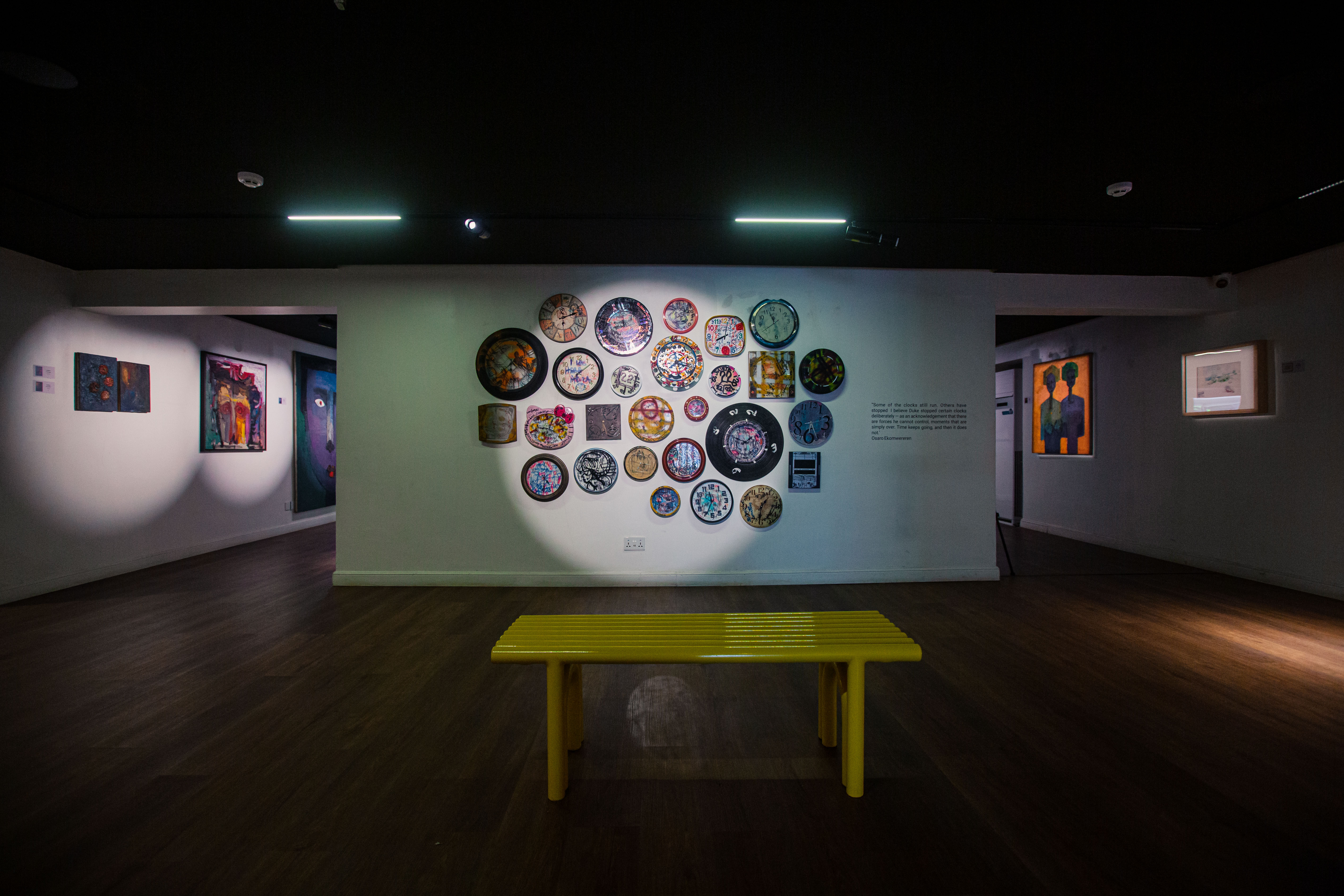
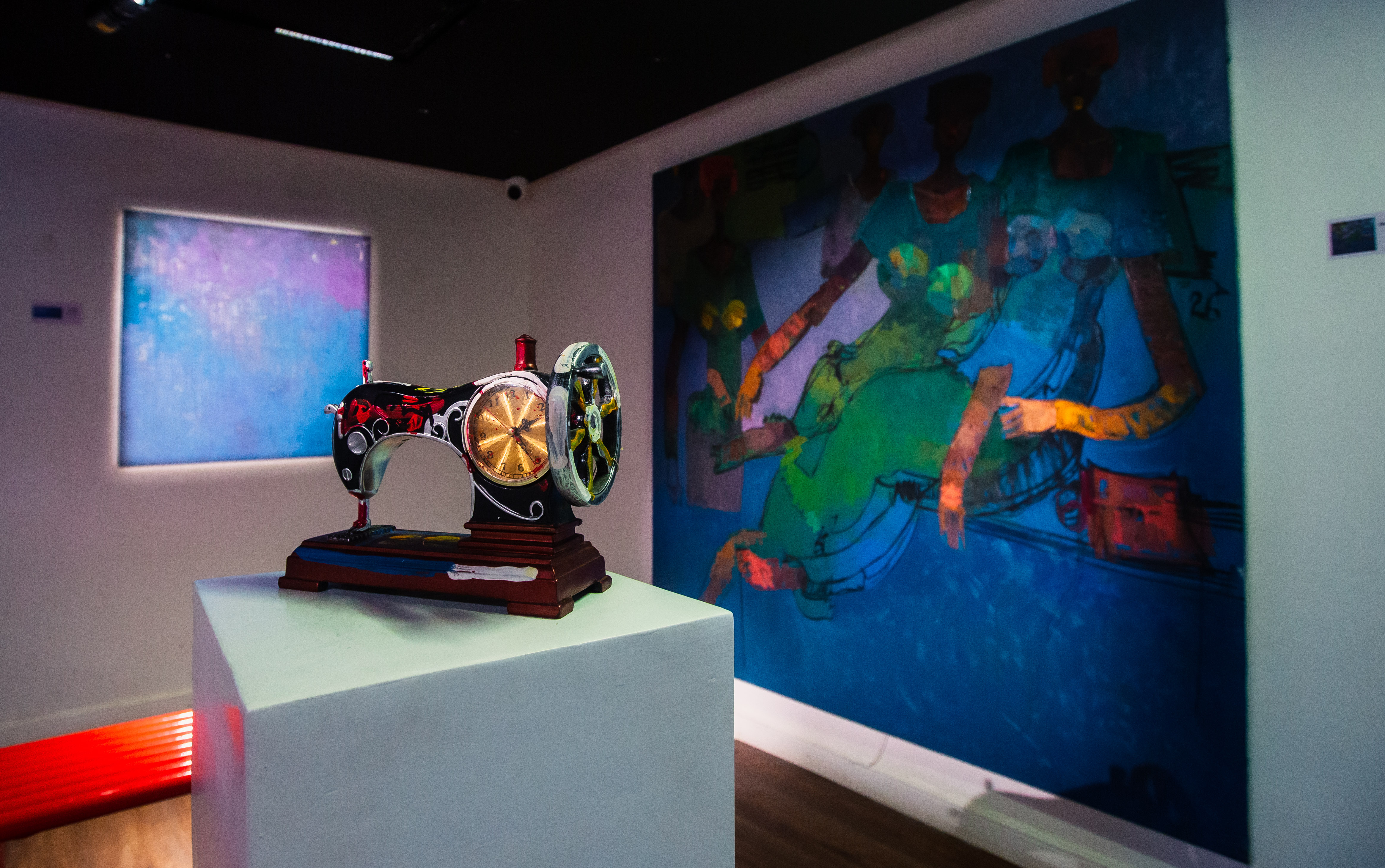
There's a section in Duke Asidere's exhibition at Adegbola Gallery where the lights are meant to be dim. Wall clocks — some ticking, some stopped, a few with dead batteries left in on purpose — hang alongside his paintings like a second body of work. One marks his son's seventeenth birthday. Another, handcrafted and found in a shop in Delta, has no real function beyond keeping time for its own sake. A third stopped the day his mother died, a year and a half ago, and he has kept it exactly as it broke.
"I stay in the dark, turn off the lights, and the ticking of the clock brings me an inner joy," Asidere said on opening day. It's a strange, tender detail for an exhibition that otherwise reads as a career-spanning survey — but it's also the clearest way into understanding what Asidere/Duke, on view at Adegbola Gallery in collaboration with Fresco Gallery, is actually trying to do. The show closes July 18, and it's the kind of exhibition that rewards a slow visit.
A Gallery Built on Personal Conviction
For Kayode Adegbola, the lawyer and collector behind Adegbola Gallery, this show wasn't a curatorial experiment so much as an overdue reckoning. He's followed Asidere's work for years — long before he opened a gallery, long before he started collecting it. "I think the time really was right for a proper exhibition that serves Duke's career, and that is what we set out to do," he said.
The gallery's mission, as Adegbola describes it, sits somewhere between personal passion project and institutional ambition: showing beauty, working with archival material, and building serious exhibitions spanning both the primary market for contemporary Nigerian artists and the secondary market for 20th-century Nigerian and African art. Asidere/Duke sits squarely at that intersection — an artist with a four-decade practice getting the kind of survey treatment usually reserved for institutions with far bigger budgets and much longer histories.
The partnership with Fresco Gallery, a specialist in prints and editions across the Nigerian and African art ecosystem, was as much about access as it was about ambition. "The collaboration with Fresco allows people to access editions and collectibles by the artist on the one hand," Adegbola said. "On the other hand, it was also to show that galleries are in a position to collaborate." For Fresco, it marks a milestone in its own right — Asidere's print debut giving collectors a new and more accessible way into a body of work that has largely lived as unique paintings and drawings until now.

Duke Asidere on Making…
Asidere himself pushes back gently on the language usually used to describe an artist's output. Asked why he keeps making work after four decades, he was quick to correct the framing: "Producing is a very dangerous word — don't produce. We create art." For him, the distinction matters. Creating, he said, is closer to learning to swim or learning to drink — an instinct, a form of play, "a fantastic journey" rather than a manufacturing process.
That same instinct shapes how he thinks about showing the work at all. Exhibiting isn't separate from the act of making, in his telling — it's an extension of it, a way for people to encounter something three-dimensionally rather than secondhand. He compared it to tasting chocolate: you can describe it, but putting it in your mouth is a different experience entirely.
Asked why these particular works, now, after some of them have existed for years without being shown, Asidere offered something closer to a philosophy than an explanation: the works themselves have a will to be seen, and this was simply the moment they chose to assert it. "I am just the person who preserves the works," he said. "I'm like somebody who is seeing this show for the first time" — an unusually candid admission from an artist standing in the middle of his own retrospective, looking at a body of work that has been, in his words, "selected and deselected" by forces beyond his control.
The clocks, scattered through his home as much as through the gallery, are where his relationship to time and memory becomes most explicit. Each one is tied to a person or a moment — his son's seventeenth birthday, his daughter's tenth, a piece found on a trip to Delta, a home-made clock now battered and broken but still keeping its dead mother's time. "I don't paint like adults, determining what people might like or not," he said. "Rather, I paint as a child and enjoy it in the process — just as time does its thing, regardless."
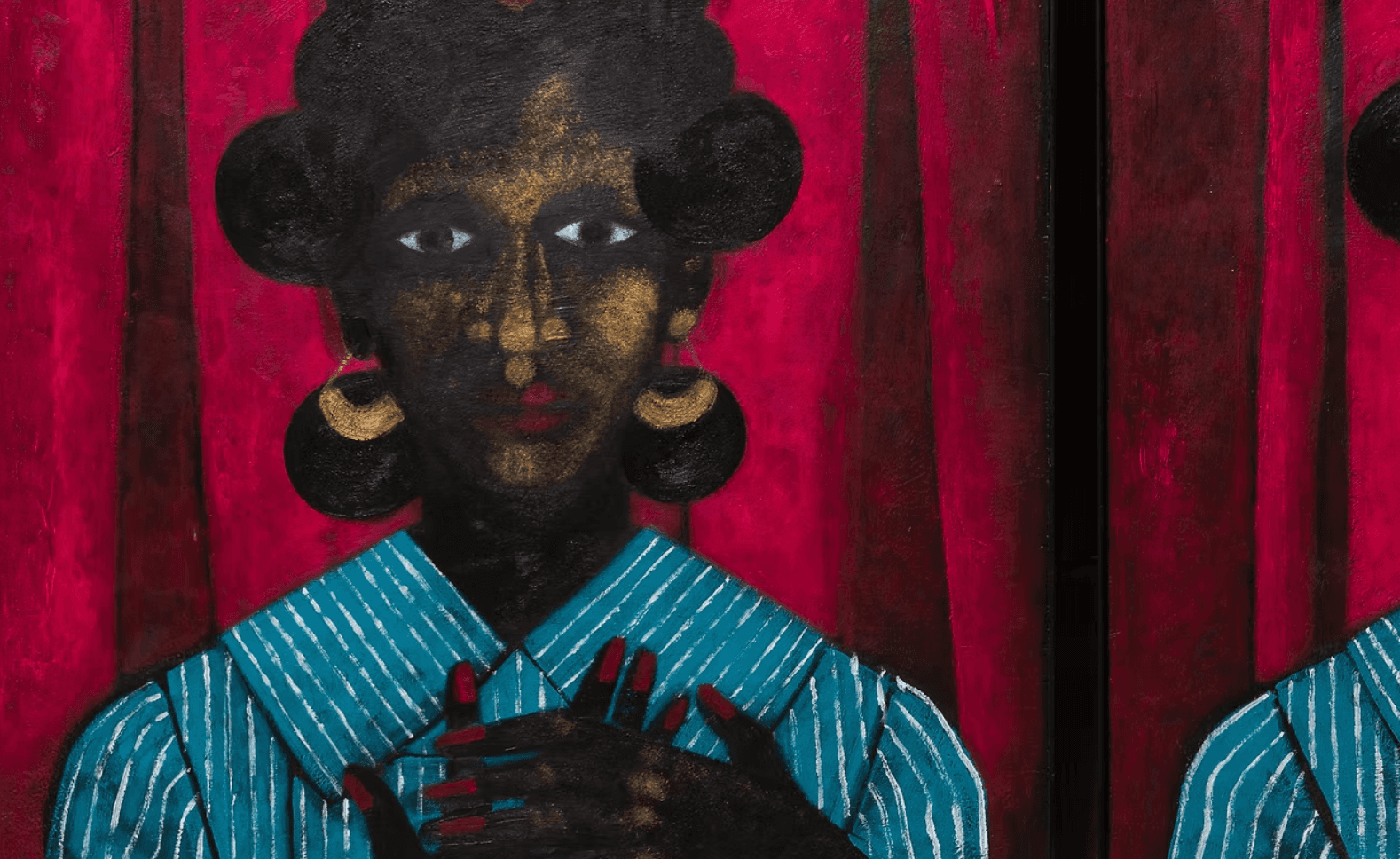
Visitors should expect two Asideres in conversation with each other, exactly as the collaborating galleries intended: the instinctive painter working from raw memory and feeling, and the disciplined, formally trained craftsman shaped by his years at Ahmadu Bello University, Zaria.
Asidere/Duke is on view at Adegbola Gallery, 1619 Danmole Street, Victoria Island, Lagos, in collaboration with Fresco Gallery, through July 18.
more stories
What's On
In Lagos, Victoria Ndubuisi and Paulcy Odama turn bodies into landscape and monumental architecture into something fragile. In Abuja, Dotun Popoola bends discarded metal until it holds movement and likeness. In Paris, four decades of Kerry James Marshall place Black figures at the centre of history painting. Three shows about what a surface can be made to carry.
3 Mins Read

What's On
A Tanzanian painter turns white space into a field of memory; a Paris gallery fills with flea-market talismans. In Lagos, one group show tests affinities across generations while another asks how traces survive in material form. Four exhibitions worth seeing this week.
4 Mins Read

What's On
From Ruth Ige and Chika Idu in Lagos to Barthélémy Toguo and Ladji Diaby in Paris, the exhibitions worth making time for now.
5 Mins Read

What's On
This week: grief and inheritance in Lagos, material memory and belonging in Paris, and Ndidi Dike’s economies of extraction in Stockholm.
4 Mins Read

What's On
At Nubuke Foundation domestic objects turn into archives of labour and belonging, Gabriel Selassie Tsagli sets the choreography of the rave against private grief and Frank Coffie makes yarn do two entirely different jobs in one room.
3 Mins Read
![Gabriel Selassie Tsagli, Rave, 2026. [wall colour and oil on canvas, 240 x 360 cm] Courtesy the artist and Gallery 1957.](https://framerusercontent.com/images/GB4ZGt77CZIaYOGRvACPSKx3rd0.png?width=631&height=404)
What's On
Stephen Tayo finds social choreography in the movements around worship, Ameh Egwuh builds a language from yellow bodies and white birds, and Ngozi-Omeje Ezema discovers what a vessel can hold after it breaks.
3 Mins Read

What's On
For nearly a decade, Yinka Ilori has been known as an artist of colour and community — the designer behind playful, technicolour public interventions across London and beyond.
5 Mins Read
What's On
From London to Lagos, New York to the French Riviera, African and diasporic artists are commanding some of the most talked-about gallery walls this summer. Here's where to go, who to see, and what to expect before the doors close.
3 mins

What's On
London Gallery Weekend returns for its sixth edition this 5–7 June, bringing together over 120 galleries across the capital for three days of exhibitions, talks, and events — all free and open to the public. For its Co-Directors Jeremy Epstein and Sarah Rustin, the 2026 edition is "a convening moment that is both local and global in its scope and audience, reflecting the year-on-year revitalisation and evolution of the capital's contemporary art scene."
4 Mins Read
What's On
On October 12, 2025, the Ecobank Pan African Centre in Lagos opens its doors to Fela Kuti: Afrobeat Rebellion, marking the return of an exhibition that celebrates one of Africa’s most influential cultural figures. Originally curated by the Philharmonie de Paris in 2022, the exhibition is now reimagined for its Nigerian debut by the A Whitespace Creative Arts (AWCA) Foundation, with support from the French Embassy in Nigeria and the Kuti family.
2 Mins Read
What's On
The Nigerian art landscape welcomed a major new institution with the launch of ADEGBOLA Gallery in Victoria Island, Lagos. Founded by lawyer and cultural entrepreneur Kayode Adegbola, the gallery officially opened its doors on October 1, 2025, Nigeria's Independence Day. The space has been established with the ambition of creating a new home for serious curatorial work that is deeply anchored in local context while maintaining global relevance.
2 Mins Read

What's On
A groundbreaking exhibition explores photography’s role in shaping Pan-African identity, solidarity, and political thought The Museum of Modern Art (MoMA) has announced a landmark exhibition titled Ideas of Africa: Portraiture and Political Imagination, opening December 14, 2025, and running through July 25, 2026.
3 Mins Read

What's On
Southern Guild is set to make its third consecutive appearance at The Armory Show, presenting a powerful new body of work at Booth 117 of the Javits Center. The presentation, on view during the VIP Preview on September 4 and to the public from September 5–7, will feature new paintings, sculpture, and photography from a roster of seminal artists from South Africa, Morocco, Benin, and Nigeria.
2 Mins Read

What's On
Victoria Ndubuisi’s distinctive approach to painting captures attention in a remarkable way. In her ongoing solo exhibition titled "Ọmụgwo," she employs a unique marbling technique for the backgrounds of her artworks, created through the dynamic act of performance.
3 Mins Read

What's On
O’DA Art is pleased to present, Walk like a Champion, Abe Odedina’s first solo exhibition in Lagos, Nigeria. This new body of work is a testament to this special gathering and the thrilling opportunity to finally exhibit in Nigeria again and most importantly, to make a show for his Mother ahead of the centenary of her birth. Its title, that Odedina attests, ‘is not about swagger. It’s not about strutting around. It’s about what you think a champion is? It’s about being undeniably true to yourself. When we say “walk”, it’s in a more important sense than one foot in front of the other. It’s how you go through life. It’s the Big Walk.’
2 Mins Read