
Art News
Francis Kéré Just Built Germany's First Purpose-Built Cultural Home — In Senegal
The Goethe-Institut has operated for more than 75 years without ever commissioning a building of its own. It chose Dakar, and a Burkinabè architect, to break that streak.
SHARE
3 min

The Goethe-Institut opened the doors of its new Dakar headquarters on April 16, marking the first time in the institution's 75-year history that it has commissioned a building from concept to completion. The architect is Diébédo Francis Kéré, the Berlin-based, Burkina Faso–born designer who in 2022 became the first African laureate of the Pritzker Prize.
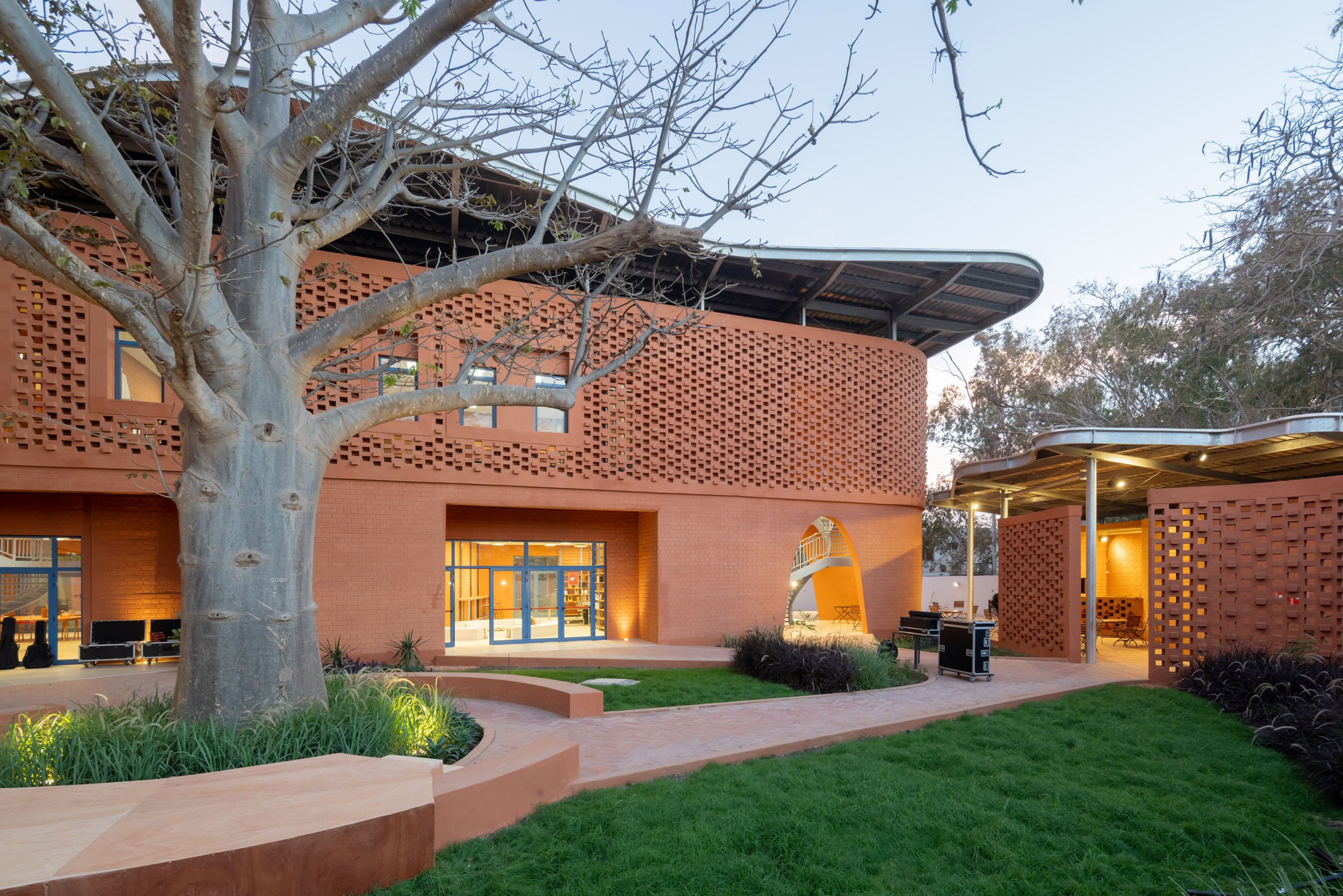
Kéré's firm delivered roughly 1,800 square meters on Dakar's Corniche Ouest, in the Senegalese capital's museum quarter, near the Léopold Sédar Senghor Museum. The building wraps a courtyard organized around a mature baobab tree that predates the construction — the architects built around it rather than through it. Load-bearing walls, interior partitions, and a perforated outer screen are made from locally sourced compacted-earth blocks, cooled largely by passive cross-ventilation rather than mechanical systems. The project ran from 2018 to 2026, cost roughly 4 million euros, and involved the Dakar-based firm Worofila alongside German engineers and local artisans and contractors.
Kéré was born in Gando, Burkina Faso, and left for Germany on a carpentry scholarship before training as an architect. His first completed building, the Gando Primary School of 2001, was built with labor and material contributed by the village itself, using local clay bricks and an overhanging roof designed to shed heat rather than trap it. The same logic — local material, passive climate control, construction as a collective act — carries through to Dakar, more than two decades and a Pritzker Prize later.
Kéré has described his early education work as inseparable from the idea of gathering, noting that spaces built for learning tend to become spaces where communities meet. The Goethe-Institut's Dakar building takes that instinct and gives it scale: an auditorium, a library centered on African knowledge, classrooms, a rooftop terrace, and a program of talks, film screenings, and concerts, all housed under a canopy shaped to echo the tree cover the site once held.

For decades, the story of German and European cultural institutes on the continent has been one of imported form: buildings designed elsewhere, shipped in as models of what culture should look like, regardless of climate, material, or local labor. Dakar reverses the direction of that transmission. The institution built to project German culture abroad is, for the first time in its history, standing inside a structure designed by an African architect, built from African earth, by African hands.
more stories
Art News
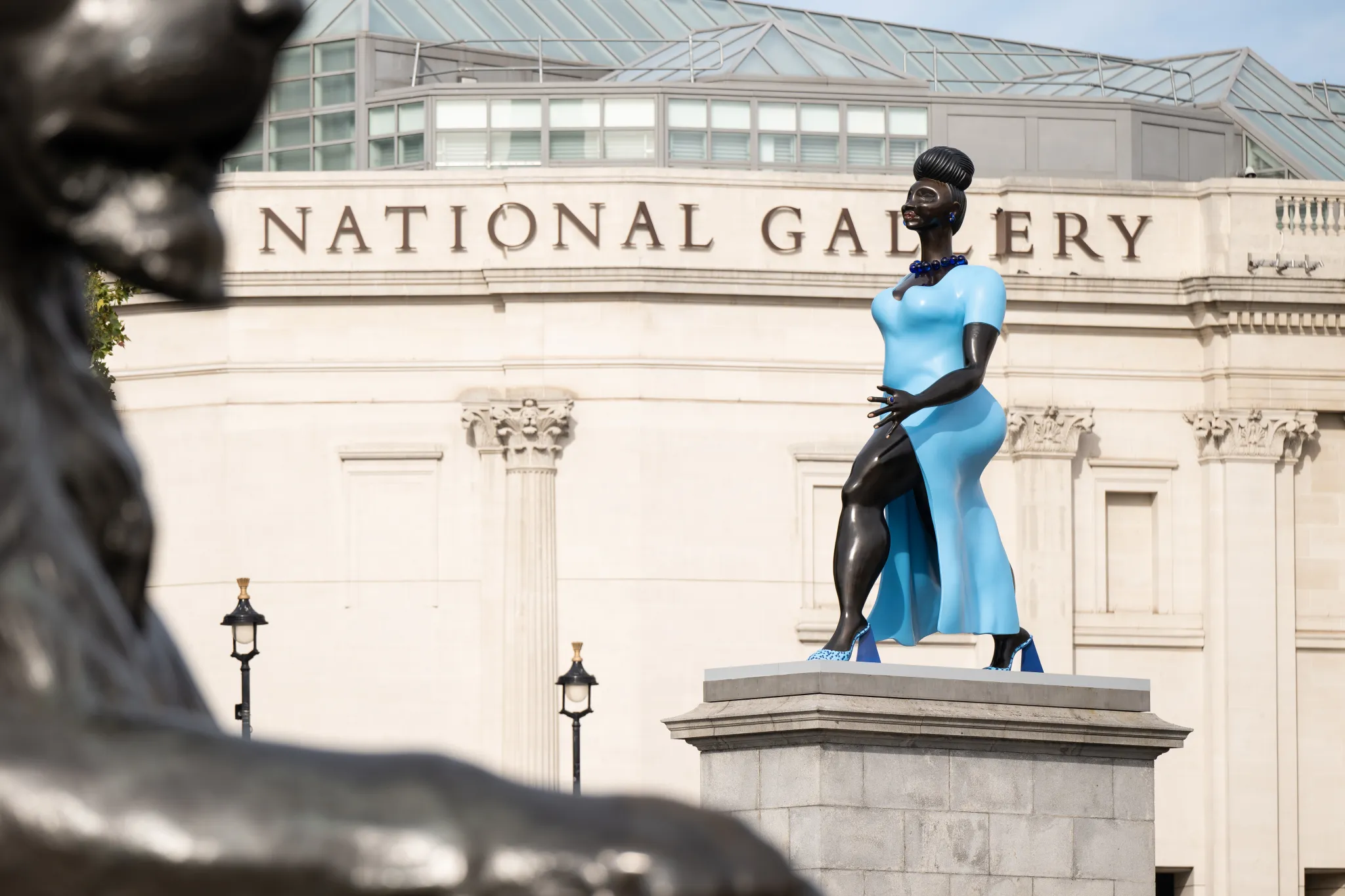
Tschabalala Self’s Lady In Blue has arrived at London’s Trafalgar Square, transforming the iconic Fourth Plinth with a monumental portrait of the contemporary woman.
3 Mins Read
Art News
History was made this year at FNB Art Joburg. Sculptor Kelebogile Marope has been announced as the winner of the 2026 FNB Art Prize — becoming the first artist from Botswana to ever take home the award since its inception nineteen editions ago.
3 Mins Read

Art News
Appointment of Elvira Dyangani Ose as the artistic director of Zeitz Musuem of Contemporary Art, Cape Town. The choice that signals both continuity and a widening of horizons.
3 Mins Read

Art News
Tiwani Contemporary is closing its London doors. The gallery, which has operated out of 24 Cork Street in Mayfair since 2023 will shut its London space after already pausing operations at its Lagos outpost on Victoria Island.
3 Mins Read

Art News
Polish philanthropist and art advocate Omenaa Mensah, of Ghanaian heritage, has been invited to join the prestigious Africa Acquisitions Committee (AAC) at Tate, one of the world’s most influential cultural institutions. Her appointment not only marks a milestone as the first Polish member of the Committee but also underscores Warsaw’s growing significance on the global art world.
2 Mins Read

Art News
This November, Lagos will host a milestone edition of ART X Lagos — the fair turns ten. Since its founding in 2016 by Tokini Peterside‑Schwebig, ART X Lagos has grown into West Africa’s premier art-fair and a benchmark for contemporary African art.
2 Mins Read

Art News
The UK government has acquired Journaliste (2023), a powerful mixed-media animation by British-Congolese artist Djofray Makumbu, for the nation’s public art collection, marking a major milestone in the artist’s rising career.
2 Mins Read

Art News
In the latest twist in the ever-blurring lines between internet virality and art world credibility, American artist KAWS has publicly denied any collaboration with London-based Nigerian artist and designer Slawn, following a now-viral post shared by Slawn suggesting a joint project between the two.
2 Mins Read

Art News
The Museum of West African Art (MOWAA) will officially open its new museum campus in Benin City, Nigeria, to the public on Tuesday, 11 November 2025. The opening marks a major milestone in the institution’s vision to build world-class infrastructure for the research, preservation, and presentation of West African art and heritage.
2 Mins Read

Art News
The upcoming Aichi Triennale 2025, set from September 13 to November 30 in Japan, promises a reformative global dialogue on contemporary art. Under the evocative theme A Time Between Ashes and Roses—a nod to Adonis’s 1970 poem—the festival goes beyond mere traditional national narratives, inviting diverse perspectives that reimagine our connection to time, nature, and society. Among the 60 selected artists, a powerful contingent from Africa brings distinct voices and innovative practices to the international stage. Here’s a closer look at five remarkable African artists featured in this year's Triennale.
3 Mins Read

Art News
Art Basel has unveiled the lineup for its 2025 edition in Basel, Switzerland, set to take place from June 19–22, with preview days on June 17–18. The fair, widely regarded as a bellwether for the global art market, will host 291 galleries, including major blue-chip establishments and an expanded focus on ultra-contemporary art through a newly introduced section—Premiere.
3 Mins Read

Art News
Art Basel has unveiled its latest initiative—the Art Basel Awards—a groundbreaking recognition platform set to spotlight artists, curators, and influential figures who shape the global art landscape. This ambitious program underscores Art Basel’s growing commitment to acknowledging excellence and fostering innovation across artistic disciplines.
2 Mins Read

Art News
The British-Nigerian artist and designer Yinka Ilori has transformed Sotheby’s café on New Bond Street with his distinctive style, infusing the space with vibrant adire motifs, bold symbols, and colorful furnishings. The installation, titled "Pride is Within My Story," runs until October 31, and celebrates the diverse talents that have made London their home while highlighting the city's inclusive artistic community.
3 Mins Read

Art News
An African art collection is once again set for auction after its owner, Sam Njunuri, filed for bankruptcy earlier this year. The collection, comprising over 1,000 pieces including sculptures and monuments, has been at the centre of a legal dispute dating back to 2015.
1 Min Read

Art News
First major UK solo exhibition of new and recent works by Lagos-based artist Nengi Omuku, exploring her profound relationship with the natural world.
3 Mins Read

Art News
Opening on 9th Ocotober, 2023, ‘PORTRAITS FOR ENGLISH TO SEE’, presents six new works that are part of René Tavares’ most recent and iconic painting series – “Portraits for English to See” and “Cotton People Reloaded”.
2 Mins Read

Art News
Art on the Underground, London, United Kingdom is set to present an exciting seminal performative work, Declaration of Independence, featuring multifaceted London-based artist, educator, and researcher, Barby Asante. This newly commissioned iteration will take place at Stratford Tube station on Sunday 17 September 2023.
1 Min Read

Art News
Retro Africa Debuts at Art Basel Hong Kong with solo presentation of Victor Ehikhamenor’s Tapestries
Art Basel Hong Kong, will welcome a new participant this year: Retro Africa, a contemporary art gallery based in Abuja, Nigeria. This will be the gallery's first appearance at the prestigious fair, where it will present a solo show by Nigerian-American artist Victor Ehikhamenor.
2 Mins Read

Art News
The EMOWAA (Edo Museum of West African Art) Trust has announced the appointments of two distinguished art pioneers to strengthen its focus on modern and contemporary art. Professor Chika Okeke-Agulu, a Nigerian art historian and professor at Princeton University and Oxford University, will serve as Senior Advisor, Modern and Contemporary Art. Aindrea Emelife, a Nigerian-British curator and Forbes 30 Under 30 honoree, will be the new Curator of Modern and Contemporary Art.
2 Mins Read

Art News
What does it mean to be green in a world that has been shaped by colonialism and capitalism? How can we rethink our relationship with nature and each other in the face of ecological crisis and social injustice? How can we reclaim and celebrate the diverse and sustainable ways of living that have been erased or marginalized by the dominant narratives of progress and development?
3 Mins Read

Art News
'El Anatsui is responsible for some of the most unique and unforgettable sculptures in recent times and we are delighted that he will tackle the Turbine Hall this autumn for the annual Hyundai Commission,' said Frances Morris, Director of Tate Modern.
1 Min Read

Art News
In a time where diversity and inclusion are becoming more important in the art world, the exhibition, In the Black Fantastic, is a timely and impactful exhibition that spotlights Black African Contemporary artists. Curated by Ghanaian-British Writer & Curator, Ekow Eshun, the exhibition was initially held at the Hayward Gallery in London where thousands of spectators flocked to view the work in its entirety. As a result , the exhibition has now been reopened at the Kunsthal Museum in the Netherlands.
2 Mins Read