
Editorials
REVIEW: An Architecture of Refusal
In Abuja, a single open bookshelf is set against the quiet closure of the law. The staging is too sparse for its subject; the performance and the manuscript that travel with it are not.
SHARE
4 Mins Read
On 2 August 2019, Abubakar Idris — known to thousands online as Dadiyata — was abducted from his home in Kaduna by unknown armed men. He was 34, a university lecturer, a husband, a father, and a relentless political commentator. Seven years on, under section 164(1) of the Evidence Act 2011, he may now be legally presumed dead: a rebuttable presumption that arrives without naming a perpetrator, without an account of what happened, and without justice. It offers the form of closure while answering nothing. Where Is Dadiyata? — an ambitious travelling exhibition, manuscript and public intervention developed under the Goethe-Institut Nigeria’s Art & Country initiative — is built specifically to deny that closure. The project is a counter-event to the legal threshold.
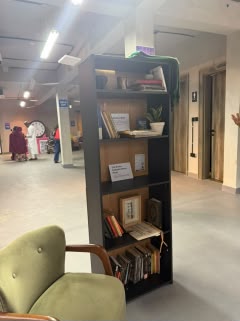
In its Abuja edition, hosted at the Gatefield Office, a public strategy and media group, the exhibition rests on a single stark spatial gesture: a plain wooden bookshelf standing isolated in the centre of the room beside an empty chair. The shelf holds the man’s physical relics — his books, garments, prints, and a radio playing music he listened to.

As an architectural decision, the open shelf functions as an anti-coffin. Where a coffin closes a life to bury a body, the open shelf holds memory, text and questions in public circulation. And yet in Abuja, a city that held very little of Dadiyata’s life, the installation risks feeling sparse. Standing alone at the centre of the room, the shelf lacks the contextual scaffolding to flesh out the man behind the handle. Viewers are left confronting a solitary object that holds his belongings without fully conveying his trajectory, and the space feels diminished by it. A deeper account of the man, and of the motivations behind his politics, could have been drawn out here.
That physical sparsity was electrified by live performance. Opening the show, the spoken-word poet Al Amin Al Hassan delivered a haunting rendition of his poem Silence as Language, turning the room’s quiet into a visceral confrontation with what the project frames as state-sponsored erasure. Hassan’s performance bridged text and space, demonstrating how oral performance can activate an otherwise minimal environment.
Beyond its physical components, the exhibition raises uncomfortable questions about public memory and the making of civic heroes. In the years since his disappearance, public discourse, including Amnesty International’s 2020/21 report, has repeatedly canonised Dadiyata as an “activist”. The manuscript records something more precise: he was a university lecturer, an outspoken political commentator, and a champion of the Kwankwasiyya movement. Reframing him as a neutral activist exposes the limits of public memory — how a society processing state violence flattens partisan actors into broad civic symbols to make their loss universally consumable. Acknowledging that Dadiyata was a partisan critic does not excuse his disappearance. It sharpens the point: in Nigeria, even belonging to an opposition network offers no protection against total erasure. Where the Abuja exhibition is minimal, the accompanying manuscript provides a rigorous counter-archive.
2
Across three sections — Part I: The Question, Part II: Memory Refuses, and Part III: Disappearance & Refusal — it gathers essays, poetry, legal analysis and visual archives. Seyi Lasisi applies a sharp political analysis to the deliberate mechanism of state-sponsored erasure and its use as public discipline. Ogochukwu Umeadi offers a biting satire, 66 Ways to Completely Erase a Man, breaking down the administrative procedure that turns horror into background noise. Sulaiman A.M. draws a brilliant historical parallel in The Pattern That Eats Its Own, setting the failed 1984 kidnapping of Umaru Dikko in a wooden crate against Dadiyata’s 2019 disappearance into fog. The project demonstrates how contemporary art and curatorial intervention can serve as tools for civic reflection. The Abuja layout would have benefited from a richer spatial framework to match its emotional stakes. But the broader project succeeds in transforming a legal threshold into an ongoing public trial. In refusing the neatness of legal closure — and as it travels on to Kaduna and then Lagos — the exhibition ensures that until the state provides answers, the question remains unburied. We continue to ask: Where Is Dadiyata?
Where Is Dadiyata? was presented at the Gatefield Office, Abuja, from 2 to 20 August 2026, and travels to Kaduna and Lagos. The project is the 2026 edition of Art & Country, an initiative of the Goethe-Institut Nigeria.
Aisha Aliyu-Bima is a writer and critic based in [city]. [One-line bio to be supplied.] All photographs by Aisha Aliyu-Bima.
more stories
Editorials
Thread that turns into faces, bronze that becomes a crowd, ceramic coral clinging to a sunken object, a "painting" that turns out to be a quilt: the Nigerian artist Jacqueline Suowari takes us on a tour of the fair at the Javits Center in New York, pointing out the five works that rewarded her for stepping closer.
8 Mins Read

Editorials
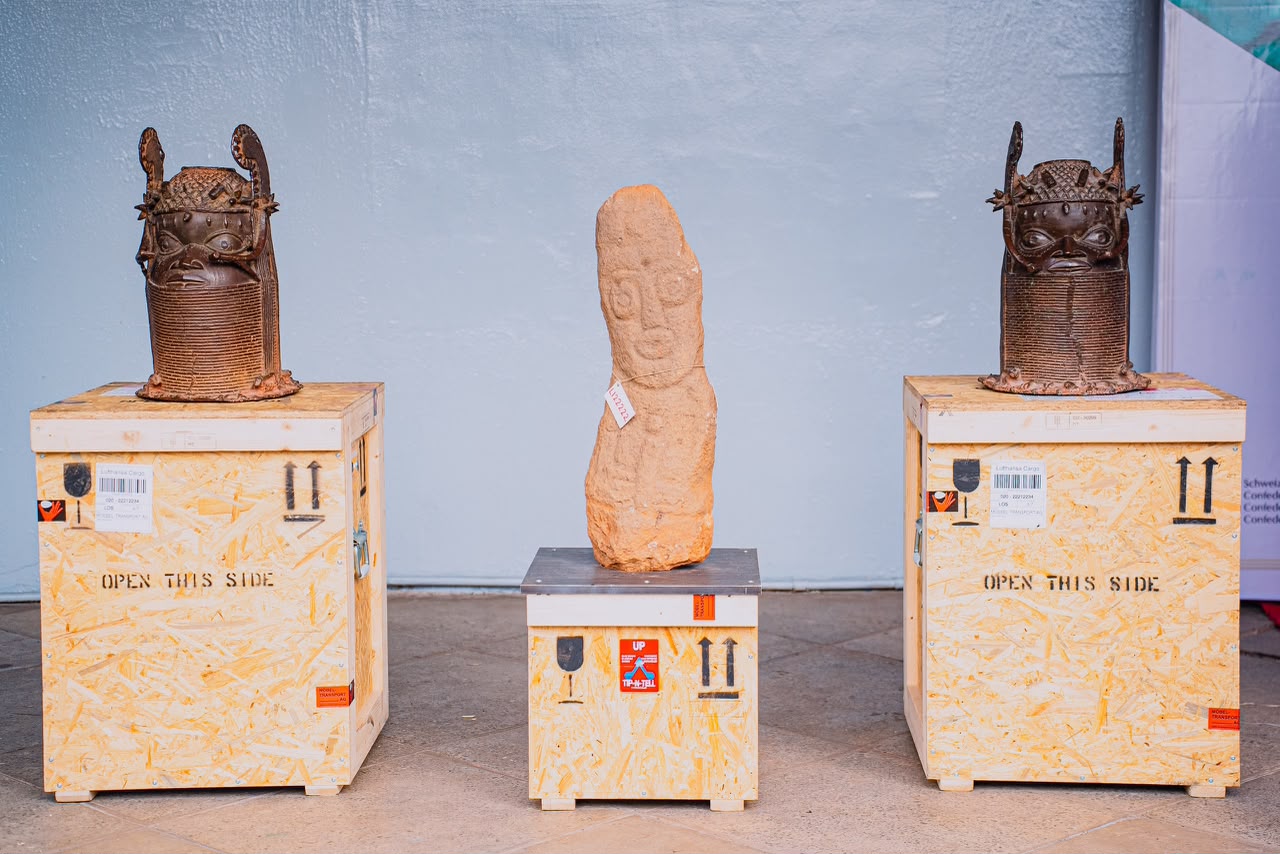
Switzerland's return of eighteen Benin Bronzes and four Ikom monoliths is a milestone in a restitution movement that is starting to outpace the institutions meant to receive it.
8 mins
Editorials
Dianna Offor, nicknamed "God's Artist," is a Nigerian-born visual artist, whose work is dedicated to expressing the essence of God and importance of faith in todays society. Currently living in Ireland–where she recently acquired a diploma in studio art painting, Offor has spent the last three years depicting the theme of Hope and Love through her biblical abstract paintings.
13 Mins Read

Editorials
Last week, Art Report Africa served as the official media partner for New Narratives and Singular Communication in Arts Journalism: The Museo del Prado Experience — a two-day international workshop held at the Yemisi Shyllon Museum of Art, Pan-Atlantic University, Lagos, organised in partnership with the Embassy of Spain in Nigeria and Casa África through its #PeriodismoÁfrica programme.
2 Mins Read

Editorials
On 14 June 2026, the Obama Presidential Center unveiled "The Obamas: Springing Forth" — a large-scale work by Njideka Akunyili Crosby, rendered in acrylic, coloured pencils, charcoal, and transfers on paper, measuring 108 by 120 inches. It now hangs in the Hope and Change Lobby of the museum's main building, free and open to the public, before the Centre's official grand opening on Juneteenth. It is the first official portrait of the former President and First Lady together.
3 Mins Read

Editorials
The 2026 Venice Biennale is, on paper, the most African edition in the exhibition's 131-year history. But what does that actually mean — and who does it serve?
5 Mins Read

Editorials
The Pavilion of Zimbabwe announces its participation in the 61st International Art Exhibition of La Biennale di Venezia, opening in April 2026 under the artistic direction of Adriano Pedrosa and the central exhibition In Minor Keys.
2 Mins Read

Editorials
There's a voice that lives inside us, often waiting in silence. It's a part of ourselves that we sometimes bury, a quiet shadow that only finds expression when we allow it to. Yusuff Aina's latest character, "Voied," is a compelling new light for this hidden self.
3 Mins Read

Editorials
In response to a growing chorus in the global art world declaring that “Black figuration is over,” O’DA Art Gallery’s latest exhibition, Black Figuration is Alive and Well, offers a firm and timely rebuttal. Bringing together a dynamic group of contemporary artists working across painting, sculpture, photography, collage, and digital media, the exhibition argues for figuration not as trend or aesthetic repetition, but as a vital language of presence, imagination, and agency.
2 Mins Read

Editorials
In the nuanced world of art collecting, the process is often as significant as the acquisition itself. Whether motivated by aesthetic appreciation, investment potential, or cultural enrichment, collectors must ensure that their decisions reflect both their personal values and long-term vision.
3 Mins Read

Editorials
For the first time in art market history, female African artists collectively surpassed their male counterparts in auction sales in 2023—a development initially dismissed as an anomaly. Yet, the trend persisted into 2024, with women artists securing a commanding 52.8% share of total African art sales.
3 Mins Read

Editorials
At a time when conversations about diversity, representation, and identity are more important than ever, Bozar’s latest exhibition When We See Us offers a powerful exploration into how we perceive ourselves and others.
1 Min Read

Editorials
Curated by Osei Bonsu, curator of international art at Tate Modern, and Cale Garrido, guest curator at the C/O Berlin Foundation, A World in Common presents twenty-three African and African diaspora artists from different generations and geographical contexts - with works by Kelani Abass, Atong Atem, Malala Andrialavidrazana, Edson Chagas, Kudzanai Chiurai, Rotimi Fani-Kayode, Maïmouna Guerresi, Hassan Hajjaj, Délio Jasse, Julianknxx, Samson Kambalu, Kiripi Katembo, Lebohang Kganye, Mário Macilau, Sabelo Mlangeni, Santu Mofokeng, Fabrice Monteiro, Aïda Muluneh, Wura-Natasha Ogunji, George Osodi, Dawit L. Petros, Zina Saro-Wiwa, and Khadija Saye.
2 Mins Read

Editorials
As September gets to its mid point, now is a good time to look at what October promises for the art world, with fairs and auctions spanning continents, spotlighting both emerging and established talent.
3 Mins Read

Editorials
Imagine growing up surrounded by art that wasn't just on the walls, but woven into the very fabric of Lagos. That was the world of Mrs Rayo Anthonio, daughter of the legendary Yusuf Grillo.Yusuf Grillo's story is one of dedication and quiet revolution.
5 Mins Read

Editorials
Anjola Awosika gives insight to his mission for this series: "I'm on a mission to unfold the vibrant African narrative through the lens of food and interior photography. I thrive on encapsulating the richness of our diverse culture in every shot, whether it's the savory essence of our cuisine or the allure of stunning interior spaces. Join me in this exhilarating journey at the core of my media agency, where we celebrate the beauty of African life through the captivating art of photography."
1 Min Read

Editorials
Debuting this month, Anjola Awosika announces "Ànjolá", an Interior Design project celebrating African culture in African homes. Looking at how functionality, comfort and Art coalesce in living spaces, Awosika is determined to document the intricate details that contribute to the beauty of specific African homes.
1 Min Read