
Editorials
“Mémoire Matérielle”: Can Materials Hold Memory?
Mémoire Matérielle”: Can Materials Hold Memory? The exhibition at 193 Gallery in Paris rethinks memory as a material process through works that explore preservation, repair, transmission and colonial afterlives.
SHARE
8 Mins Read

Spread across three interconnecting rooms on the ground floor of 193 Gallery, Mémoire Matérielle brings together four artists—Gaëlle Choisne, Joana Choumali, Andile Dyalvane and Carla Gueye—and opens with a dialogue between the works of Choisne and Choumali.
Choumali’s series Alba’hian—meaning the first light of day in the Anyin language—is an amalgam of delicately embroidered photographs in which sheer voile, gold and figures merge into the soft light of dawn. As with much of Choumali’s work, these pieces are built from what began as ordinary photographs of landscapes, silhouettes and streets, collected mostly in Abidjan, where the artist is based. Layered with embroidery, however, these fleeting moments become a delicate, tactile surface that lures you in with some semblance of the seen only to leave you inside a rêverie.
How can the hand bear witness to histories and heritages that have been displaced or erased? That is the curatorial proposition, a challenge taken up by Azu Nwagbogu and Nkhensani Mkhari, curators of Mémoire Matérielle. Taking its cue from the gallery’s reading of the writer Paulette Nardal’s proposition that consciousness does not simply pass from one generation to the next, the exhibition focuses on how the hand can become a primary instrument for the reconstruction of a common whole, across practices that involve clay, textile, image, surface and assemblage. But if anything, the exhibition reads more like a series of shows within a show.

The exhibition climaxes with an expansive skylit room given over to Choisne’s Zantray series. Named after the Haitian Creole, zantray, meaning “entrails” or “innards”, these installations—sitting at the frontier of painting, sculpture and relief—riff on the body in its marked, wounded state.
In Zantray I, a metal grid holds a mass of acrylic resin against the wall, a kind of ritual magma. Memory here is of the flesh. Like skin, the surfaces are imperfect: uneven in tone, scabbed in places, by turns rough and glossy. A painting given an entire wall to itself immerses us further in Choisne’s use of ceramic and mixed-media materials, and draws our gaze up towards the ceiling. The light itself falls most directly on Andile Dyalvane’s iSiduli (Anthill) standing on a white plinth at the centre of the room. The mid-sized sculpture is made of a round green base that narrows into a ridged neck, then swells into an ochre dome pierced by a small opening, with two branches twisting up on both sides like horns.

Before clay becomes a vessel, sculpture or form, it is earth, gathered slowly beneath our feet through erosion, sediment and water. In this sense, clay is not simply a medium but a common ground, an ancestral matter that keeps us connected to past generations and cultures, and a metaphor for returning to oneself. If memory can at first seem fractured, these gathered artefacts, which, like clay, precede borders and disciplines, reconstruct a world of buried emotions. In a separate enclave, Carla Gueye’s new sculptures offer one of the clearest demonstrations of this idea.
Gueye has long explored the female figure and the workings of remembrance, drawing on processes of excavation and reclamation. As clay remembers, so do our bodies. In As I Am—two slabs of lime, wood, jute and metal hung one above the other, with a figure appearing upside down and cut in two at the waist across them—the body becomes an archive: a place where experience is re-inscribed and understood, shaped by encounters and passed on through gesture.
Rather than simply recovering these silenced histories and techniques, Gueye’s work with lime—traditionally used to coat and protect house walls in the Charente, where she grew up—draws on methods learned from her father to create her own visual language, treating the past not as something to be preserved or reconstructed but as a living material through which new artistic forms can emerge.

While Mémoire Matérielle shows the composite forms memory can take, what makes the exhibition particularly compelling is how differently each artist approaches the subject. It is a distinct experience, one that asks us to weigh the complex stories lying between making and recollecting, threading together the individual and the collective.
Mémoire Matérielle is on view at 193 Gallery, 24 rue Béranger, 75003 Paris, from 5 September to 31 October 2026.
more stories
Editorials
As the festival marks its 10th edition, its founder and creative director reflects on a decade of Nigerian photography and the questions raised by artificial intelligence.
5 Mins Read

Editorials
In Abuja, a single open bookshelf is set against the quiet closure of the law. The staging is too sparse for its subject; the performance and the manuscript that travel with it are not.
4 Mins Read

Editorials
Thread that turns into faces, bronze that becomes a crowd, ceramic coral clinging to a sunken object, a "painting" that turns out to be a quilt: the Nigerian artist Jacqueline Suowari takes us on a tour of the fair at the Javits Center in New York, pointing out the five works that rewarded her for stepping closer.
8 Mins Read

Editorials
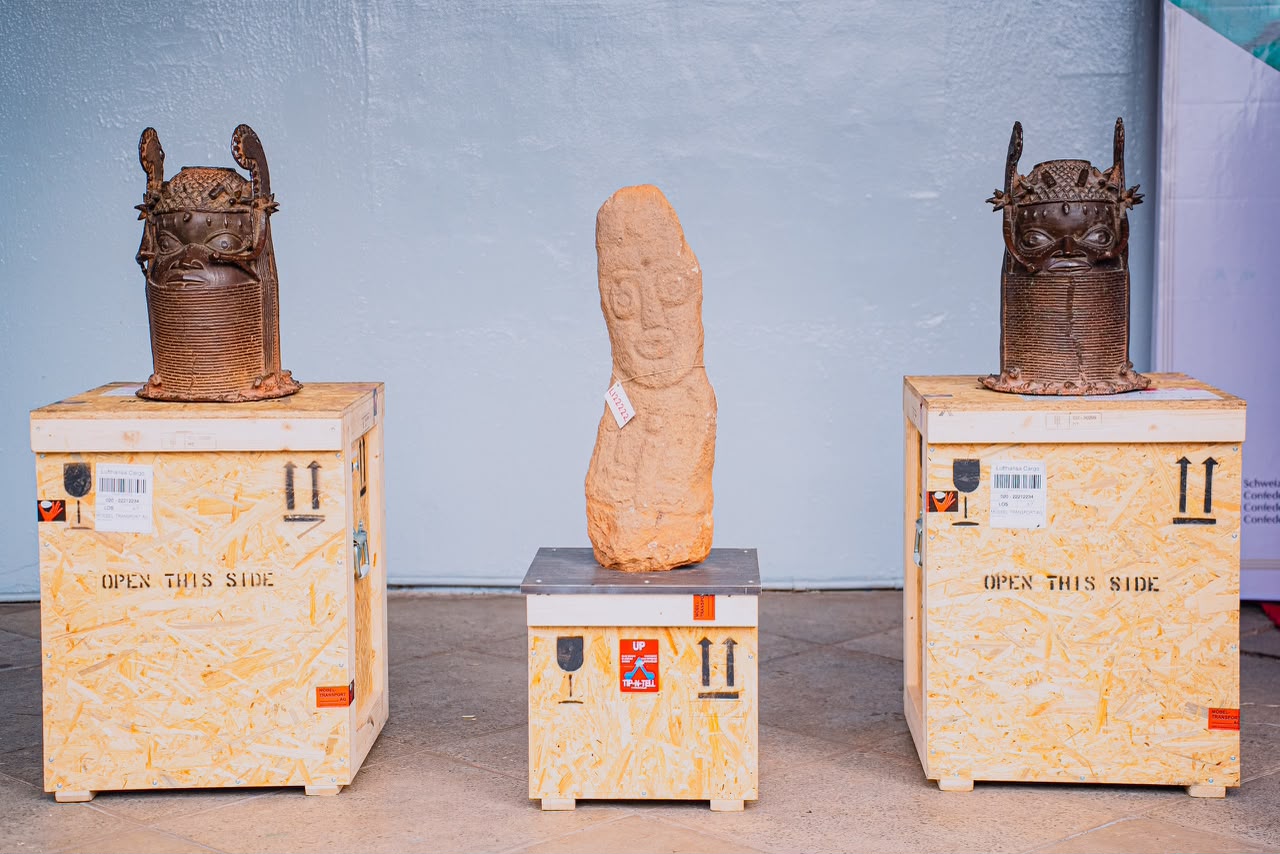
Switzerland's return of eighteen Benin Bronzes and four Ikom monoliths is a milestone in a restitution movement that is starting to outpace the institutions meant to receive it.
8 mins
Editorials
Dianna Offor, nicknamed "God's Artist," is a Nigerian-born visual artist, whose work is dedicated to expressing the essence of God and importance of faith in todays society. Currently living in Ireland–where she recently acquired a diploma in studio art painting, Offor has spent the last three years depicting the theme of Hope and Love through her biblical abstract paintings.
13 Mins Read

Editorials
Last week, Art Report Africa served as the official media partner for New Narratives and Singular Communication in Arts Journalism: The Museo del Prado Experience — a two-day international workshop held at the Yemisi Shyllon Museum of Art, Pan-Atlantic University, Lagos, organised in partnership with the Embassy of Spain in Nigeria and Casa África through its #PeriodismoÁfrica programme.
2 Mins Read

Editorials
On 14 June 2026, the Obama Presidential Center unveiled "The Obamas: Springing Forth" — a large-scale work by Njideka Akunyili Crosby, rendered in acrylic, coloured pencils, charcoal, and transfers on paper, measuring 108 by 120 inches. It now hangs in the Hope and Change Lobby of the museum's main building, free and open to the public, before the Centre's official grand opening on Juneteenth. It is the first official portrait of the former President and First Lady together.
3 Mins Read

Editorials
The 2026 Venice Biennale is, on paper, the most African edition in the exhibition's 131-year history. But what does that actually mean — and who does it serve?
5 Mins Read

Editorials
The Pavilion of Zimbabwe announces its participation in the 61st International Art Exhibition of La Biennale di Venezia, opening in April 2026 under the artistic direction of Adriano Pedrosa and the central exhibition In Minor Keys.
2 Mins Read

Editorials
There's a voice that lives inside us, often waiting in silence. It's a part of ourselves that we sometimes bury, a quiet shadow that only finds expression when we allow it to. Yusuff Aina's latest character, "Voied," is a compelling new light for this hidden self.
3 Mins Read

Editorials
In response to a growing chorus in the global art world declaring that “Black figuration is over,” O’DA Art Gallery’s latest exhibition, Black Figuration is Alive and Well, offers a firm and timely rebuttal. Bringing together a dynamic group of contemporary artists working across painting, sculpture, photography, collage, and digital media, the exhibition argues for figuration not as trend or aesthetic repetition, but as a vital language of presence, imagination, and agency.
2 Mins Read

Editorials
In the nuanced world of art collecting, the process is often as significant as the acquisition itself. Whether motivated by aesthetic appreciation, investment potential, or cultural enrichment, collectors must ensure that their decisions reflect both their personal values and long-term vision.
3 Mins Read

Editorials
For the first time in art market history, female African artists collectively surpassed their male counterparts in auction sales in 2023—a development initially dismissed as an anomaly. Yet, the trend persisted into 2024, with women artists securing a commanding 52.8% share of total African art sales.
3 Mins Read

Editorials
At a time when conversations about diversity, representation, and identity are more important than ever, Bozar’s latest exhibition When We See Us offers a powerful exploration into how we perceive ourselves and others.
1 Min Read

Editorials
Curated by Osei Bonsu, curator of international art at Tate Modern, and Cale Garrido, guest curator at the C/O Berlin Foundation, A World in Common presents twenty-three African and African diaspora artists from different generations and geographical contexts - with works by Kelani Abass, Atong Atem, Malala Andrialavidrazana, Edson Chagas, Kudzanai Chiurai, Rotimi Fani-Kayode, Maïmouna Guerresi, Hassan Hajjaj, Délio Jasse, Julianknxx, Samson Kambalu, Kiripi Katembo, Lebohang Kganye, Mário Macilau, Sabelo Mlangeni, Santu Mofokeng, Fabrice Monteiro, Aïda Muluneh, Wura-Natasha Ogunji, George Osodi, Dawit L. Petros, Zina Saro-Wiwa, and Khadija Saye.
2 Mins Read

Editorials
As September gets to its mid point, now is a good time to look at what October promises for the art world, with fairs and auctions spanning continents, spotlighting both emerging and established talent.
3 Mins Read

Editorials
Imagine growing up surrounded by art that wasn't just on the walls, but woven into the very fabric of Lagos. That was the world of Mrs Rayo Anthonio, daughter of the legendary Yusuf Grillo.Yusuf Grillo's story is one of dedication and quiet revolution.
5 Mins Read

Editorials
Anjola Awosika gives insight to his mission for this series: "I'm on a mission to unfold the vibrant African narrative through the lens of food and interior photography. I thrive on encapsulating the richness of our diverse culture in every shot, whether it's the savory essence of our cuisine or the allure of stunning interior spaces. Join me in this exhilarating journey at the core of my media agency, where we celebrate the beauty of African life through the captivating art of photography."
1 Min Read

Editorials
Debuting this month, Anjola Awosika announces "Ànjolá", an Interior Design project celebrating African culture in African homes. Looking at how functionality, comfort and Art coalesce in living spaces, Awosika is determined to document the intricate details that contribute to the beauty of specific African homes.
1 Min Read