
Editorials
Ruth Ige’s Woven Realms Finds the Body Between Worlds
In her first solo exhibition in Nigeria, the artist’s shadowed figures and shifting landscapes draw on the visual language of portraiture while keeping her subjects just beyond reach.
SHARE
8

In his 2020 monograph on the Nigerian modernist Yusuf Grillo, art historian and curator Chika Okeke-Agulu argues that colour works as a structuring device, a means of making sense of and moving between the phenomenal and metaphysical worlds. The works in Woven realms, Ruth Ige’s first solo exhibition in Nigeria (kó, Lagos, 10 September to 21 November 2026), seem to echo this sentiment. From canvases and works on paper, soft, shadowed forms emerge out of inchoate landscapes, adorned in flowing garments of sweeping brushstrokes. The dreamlike nature of the scenery we see in no way makes it unfamiliar; distant and confusing in its formlessness, maybe, but its essence is recognisable. It is the figures they hold that remain unknowable to us.
In Garden (2024), a luminous curve of cerulean blue forms a pool around which runs a textured embankment of Prussian. Three figures are shown sitting at the water’s edge with wavy plant-like forms dancing against a dense background of deep blues and violet. Of the figures, two are seated close to each other, partly subsumed into the landscape, with only their darkened limbs forming a defining contrast. The third figure demands our attention, seated slightly away from the others and draped in a muted violet-pink dress. The entire painting seems suffused by an inner ethereal light, achieved in part through transparent acrylic washes, where form and landscape melt into each other: a metaphysical state of being. Ige’s chromatic approach, echoing Okeke-Agulu’s reading of colour in Grillo, helps establish a preoccupation with shifting, transcendental planes of existence. In these works, the spaces serve to hold and cradle a body as she’s made and unmade, the earthly bound in communion with the otherworldly.
If the spaces in Ige’s paintings feel distant despite whatever familiarity we might feel, the figures who populate them remain even more obscured to us. We might identify them as women, but beyond this, we have no idea who they are. In And from your heart may cities grow (2022), the silhouetted profile of a woman is seen facing left, her head, neck and shoulder forming a solid block of dark pigment against a glowing blue background. A crescent-shaped band of bright blue swoops across the lower midground, resembling a feathered collar and a framing device from classical portraiture. The lower part of the painting is done in solid black to match the silhouette. The anonymity of this figure, contrasted against the classical framing it borrows, is perhaps the most striking quality of this painting. Where traditional portraiture is mostly concerned with an announcement of presence, a record of a body presenting itself to the artist and the world, the painting employs a process of revealing and concealing, imagining the body and states of being as familiar, yet complex and unknowable. We are thrust into the realm of the uncertain along with the characters in Ige’s painting. Perhaps we might begin resolution by mirroring their attitudes and movement through these shifting landscapes.

Ruth Ige, And from your heart may cities grow, 2022. Acrylic on canvas, 101 × 76 cm. Image reproduced from the kó exhibition catalogue.
Across the canvases, the women are shown in varying, sometimes familiar states of rest and repose, like a relaxed sitter comfortable under the artist’s gaze and confident in their composure. They appear equally comfortable under ours as well. Despite the artist’s vigorous brushwork, the bodies seem in harmony within their frenzied surroundings, presenting as both visible and opaque, creating what she refers to as “slippages between the familiar and otherworldly”. Though observable, their anonymity further adds to the strangeness of the scene, throwing into contention whatever comfort and ease we may feel. The most easily recognised quality in these paintings is the women’s poses, reminiscent as they are of modern and traditional portraiture compositions. A Madonnaesque figure occupies the majority of the picture plane in Untitled (2023). Her head and voluminous body form a pyramidal shape often found in classic portraiture, while the simplified treatment of her form evokes more modernist sensibilities. Poet in the garden (2023) shows a figure amidst a sea of blues and lilacs, her pose strikingly reminiscent of Ben Enwonwu’s dancers with their curved torsos and elongated limbs. Portraiture thus offers one way into the exhibition, which is concerned not only with bodies being newly formed but also with how they have been represented.

Ruth Ige, Poet in the garden, 2023. Acrylic on canvas, 140 × 140 cm. Image reproduced from the kó exhibition catalogue.
The figures in Ige’s smaller works on paper depart slightly from the canvases as they are shown standing or moving languorously through formless landscape. Some scenes show single women while others contain groups of twos and threes, all robed in flowing garments, surrounded by amorphous forms of blue and green made using West African indigo and acrylic, with dried ugu, bitterleaf and uziza leaves incorporated into some works. The works on paper—the most recent works in the show—belong to the numbered series Gardens and worlds within the woven realms (2026), replicating the notion of bodies amidst vegetative landscapes found in the canvases. However, the demarcation between form and environment is more obvious in these smaller pieces. Many of the figures stand stark against their backgrounds, often isolating the body from the landscape. This oscillatory position, between revealing and concealing, serves to highlight and mediate tensions between body and liminal space.

Ruth Ige, Gardens and worlds within the woven realms 1 (left) and 2 (right), 2026. Each 14.8 × 10.5 cm. No. 1: West African indigo dried pigment, acrylic paint and binder, and dried ugu, uziza and bitterleaf leaves on paper. No. 2: West African indigo dried pigment, acrylic binder and acrylic paint on paper. Image reproduced from the kó exhibition catalogue.
The exhibition text describes a narrative woven “across aspects of art, history, precolonial practices, mythology, speculative fiction, fashion, African culture, and diaspora”. While this claim doesn’t necessarily come across in its ambition, the strength of the exhibition lies in a close reading of its formal qualities and choices. Abstraction and colour help clarify what is most compelling about the show: a body’s capacity to exist in a constant state of making, finding and resolving tensions across the various spaces she inhabits.
Ruth Ige: Woven realms, kó, 36 Cameron Road, Ikoyi, Lagos, 10 September–21 November 2026.
more stories
Editorials
The Franco-Ivorian painter’s first solo exhibition in Nigeria, “Everyday Contradictions”, traces the cost of imported prosperity.
4 Mins Read

Editorials
As “You Are Special and Other Lies” debuts at the third edition of the Lagos International Theatre Festival, writer and actress Oyeyemi Adeoye and director Prosper Omesieta discuss the art of playing people who aren’t there and the possibilities opening up for Nigerian theatre.
7 Mins Read

Editorials
With his first major solo exhibition at Southern Guild in New York, we take a closer look at Chidy Wayne’s practice, his unconventional methods and the experiences that shape his work.
6 Mins Read

Editorials
Art Report Africa director Sunshine Alaibe shares five favourites from ART X Lagos 2026, from striking sculptures and compelling paintings to an exhibition revisiting the legacy of Nigerian ceramicist Ladi Kwali.
7 Mins Read

Editorials
In a windowless Addis Ababa basement, Yared Olivelli’s layered paintings ask what an archive can prove and what a doorway lets in.
6 Mins Read

Editorials
Sixty years after Flora Nwapa’s novel appeared, her great-niece revisits it and finds that what once read as failure now reads as life. Flora Nwapa: Efuru at the Threshold ran at Didi Museum, Lagos, from 24 to 31 October 2026. This is an excerpt from Ada Kalu’s essay in its accompanying publication.
8 Mins Read

Editorials
In a Peckham car park beneath a working railway, Okri performed three decades of writing alongside eighteen young people who had met only the day before. The result was tender, at times terrifying, and deliberately unresolved.
6 Mins Read

Editorials
FF Projects’ limited-edition volume, launched at Alára Lagos on 31 October, sets two Nigerian-British artists in conversation and invites a chorus of voices to answer.
8 Mins Read

Editorials
Mémoire Matérielle”: Can Materials Hold Memory? The exhibition at 193 Gallery in Paris rethinks memory as a material process through works that explore preservation, repair, transmission and colonial afterlives.
8 Mins Read

Editorials
As the festival marks its 10th edition, its founder and creative director reflects on a decade of Nigerian photography and the questions raised by artificial intelligence.
5 Mins Read

Editorials
In Abuja, a single open bookshelf is set against the quiet closure of the law. The staging is too sparse for its subject; the performance and the manuscript that travel with it are not.
4 Mins Read

Editorials
Thread that turns into faces, bronze that becomes a crowd, ceramic coral clinging to a sunken object, a "painting" that turns out to be a quilt: the Nigerian artist Jacqueline Suowari takes us on a tour of the fair at the Javits Center in New York, pointing out the five works that rewarded her for stepping closer.
8 Mins Read

Editorials
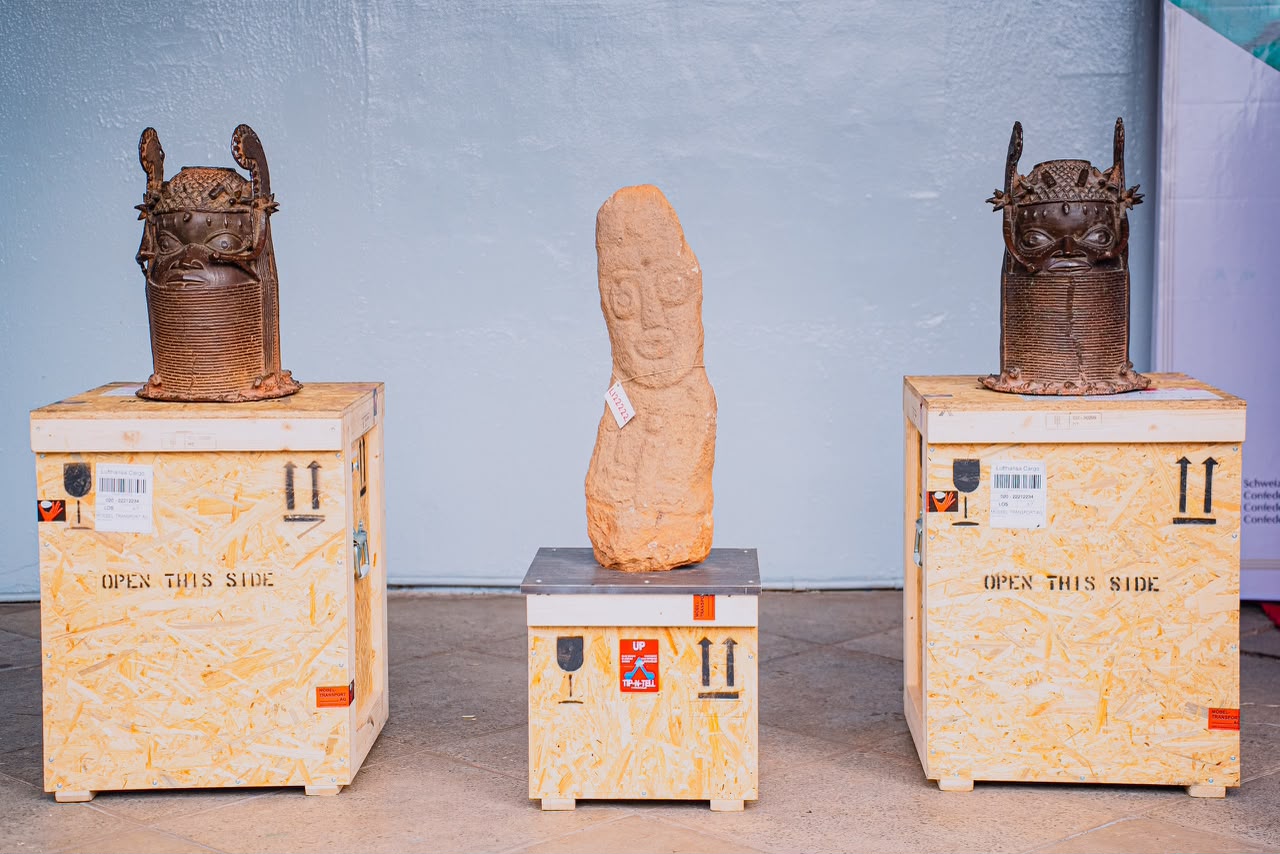
Switzerland's return of eighteen Benin Bronzes and four Ikom monoliths is a milestone in a restitution movement that is starting to outpace the institutions meant to receive it.
8 mins
Editorials
Dianna Offor, nicknamed "God's Artist," is a Nigerian-born visual artist, whose work is dedicated to expressing the essence of God and importance of faith in todays society. Currently living in Ireland–where she recently acquired a diploma in studio art painting, Offor has spent the last three years depicting the theme of Hope and Love through her biblical abstract paintings.
13 Mins Read

Editorials
Last week, Art Report Africa served as the official media partner for New Narratives and Singular Communication in Arts Journalism: The Museo del Prado Experience — a two-day international workshop held at the Yemisi Shyllon Museum of Art, Pan-Atlantic University, Lagos, organised in partnership with the Embassy of Spain in Nigeria and Casa África through its #PeriodismoÁfrica programme.
2 Mins Read

Editorials
On 14 June 2026, the Obama Presidential Center unveiled "The Obamas: Springing Forth" — a large-scale work by Njideka Akunyili Crosby, rendered in acrylic, coloured pencils, charcoal, and transfers on paper, measuring 108 by 120 inches. It now hangs in the Hope and Change Lobby of the museum's main building, free and open to the public, before the Centre's official grand opening on Juneteenth. It is the first official portrait of the former President and First Lady together.
3 Mins Read

Editorials
The 2026 Venice Biennale is, on paper, the most African edition in the exhibition's 131-year history. But what does that actually mean — and who does it serve?
5 Mins Read

Editorials
The Pavilion of Zimbabwe announces its participation in the 61st International Art Exhibition of La Biennale di Venezia, opening in April 2026 under the artistic direction of Adriano Pedrosa and the central exhibition In Minor Keys.
2 Mins Read

Editorials
There's a voice that lives inside us, often waiting in silence. It's a part of ourselves that we sometimes bury, a quiet shadow that only finds expression when we allow it to. Yusuff Aina's latest character, "Voied," is a compelling new light for this hidden self.
3 Mins Read

Editorials
In response to a growing chorus in the global art world declaring that “Black figuration is over,” O’DA Art Gallery’s latest exhibition, Black Figuration is Alive and Well, offers a firm and timely rebuttal. Bringing together a dynamic group of contemporary artists working across painting, sculpture, photography, collage, and digital media, the exhibition argues for figuration not as trend or aesthetic repetition, but as a vital language of presence, imagination, and agency.
2 Mins Read

Editorials
In the nuanced world of art collecting, the process is often as significant as the acquisition itself. Whether motivated by aesthetic appreciation, investment potential, or cultural enrichment, collectors must ensure that their decisions reflect both their personal values and long-term vision.
3 Mins Read

Editorials
For the first time in art market history, female African artists collectively surpassed their male counterparts in auction sales in 2023—a development initially dismissed as an anomaly. Yet, the trend persisted into 2024, with women artists securing a commanding 52.8% share of total African art sales.
3 Mins Read

Editorials
At a time when conversations about diversity, representation, and identity are more important than ever, Bozar’s latest exhibition When We See Us offers a powerful exploration into how we perceive ourselves and others.
1 Min Read

Editorials
Curated by Osei Bonsu, curator of international art at Tate Modern, and Cale Garrido, guest curator at the C/O Berlin Foundation, A World in Common presents twenty-three African and African diaspora artists from different generations and geographical contexts - with works by Kelani Abass, Atong Atem, Malala Andrialavidrazana, Edson Chagas, Kudzanai Chiurai, Rotimi Fani-Kayode, Maïmouna Guerresi, Hassan Hajjaj, Délio Jasse, Julianknxx, Samson Kambalu, Kiripi Katembo, Lebohang Kganye, Mário Macilau, Sabelo Mlangeni, Santu Mofokeng, Fabrice Monteiro, Aïda Muluneh, Wura-Natasha Ogunji, George Osodi, Dawit L. Petros, Zina Saro-Wiwa, and Khadija Saye.
2 Mins Read

Editorials
As September gets to its mid point, now is a good time to look at what October promises for the art world, with fairs and auctions spanning continents, spotlighting both emerging and established talent.
3 Mins Read

Editorials
Imagine growing up surrounded by art that wasn't just on the walls, but woven into the very fabric of Lagos. That was the world of Mrs Rayo Anthonio, daughter of the legendary Yusuf Grillo.Yusuf Grillo's story is one of dedication and quiet revolution.
5 Mins Read

Editorials
Anjola Awosika gives insight to his mission for this series: "I'm on a mission to unfold the vibrant African narrative through the lens of food and interior photography. I thrive on encapsulating the richness of our diverse culture in every shot, whether it's the savory essence of our cuisine or the allure of stunning interior spaces. Join me in this exhilarating journey at the core of my media agency, where we celebrate the beauty of African life through the captivating art of photography."
1 Min Read

Editorials
Debuting this month, Anjola Awosika announces "Ànjolá", an Interior Design project celebrating African culture in African homes. Looking at how functionality, comfort and Art coalesce in living spaces, Awosika is determined to document the intricate details that contribute to the beauty of specific African homes.
1 Min Read