
Editorials
Yared Olivelli: “Way in // Way out”
In a windowless Addis Ababa basement, Yared Olivelli’s layered paintings ask what an archive can prove and what a doorway lets in.
SHARE
6 Mins Read

The compound was surprisingly busy. The children were leaving the school, cars were moving around and the noise was constant. I passed through the security gate and descended the staircase. With each step, the city noise receded. By the time I pushed through the glass door into the gallery, the atmosphere had changed.
Way in // Way out, curated by Dr Semen Kumurzhi, opened at the Italian Cultural Institute in Addis Ababa on 23 June 2026. Its run was extended, and closed on 30 October 2026.
The gallery is in the basement, with no windows or natural light. The artificial lights were dim, and I found myself wishing for more light. A large table around the central column displayed posters and catalogues. Most of the artwork was square. I was the only visitor. That made the experience feel quite personal, but also a little lonely.
Architecturally, the gallery pushed me to experience the psychological and spiritual concerns of Way in // Way out with a movement established through the space. The gallery changes how the works are encountered, while the works in turn make the gallery feel like a space in which something is being remembered and concealed.
From the left, the exhibition begins with Gratitude // ምስጋና (3), with the force of an encounter. The work brought me back to a childhood memory of entering a church and seeing women gathered in prayer. Looking at some of the figures, I found myself thinking of my mother and the women I remember seeing in the church when I was very young. The figures dressed in white netela, the traditional cotton shawl, appear within a fog that recalls the frankincense smoke of an Ethiopian Orthodox church. The fog gathered above the figures produced the impression that something was suspended between the visible and invisible.

I couldn’t smell the frankincense, but the fog forced me to imagine the interior of the church. The works do not reproduce the church as a documentary image, but they activate a memory of being there. The fog carries an emotional and sensory knowledge of the church, held in the body rather than in documentation. The women feel that something is there beyond their bodies: a memory of ritual and an encounter with what cannot be seen.
Close by, Unfinished Memory // ያልተቋጨ ትዝታ (3) and (4) introduce a field of uncertainty. The archival imagery in Unfinished Memory (3) appears unsettled and unstable. The figures float rather than rest securely within the composition. An archive provides evidence for preserving and retrieving the past. What happens when the archival image will not settle into that evidence? What emerges when the image appears fragmented or incomplete?

Olivelli works with acrylic, oil and image transfer, adding another layer of painting marks in the transfer imagery. The images remain recognisable, while the paint alters the way we see them. The layering creates the tension between the trace and his artistic intervention. His compositions are a little bit too complicated. In the works, the images and forms do not always appear grounded. Their suspension raises questions about the memory that we try to contain. What is our history? What happens when its foundations become uncertain?

Way in // Way out holds all these questions open. The title suggests movement in two directions: an entrance may also be an exit.
One of the works that stayed with me, Above // ከላይ (1), contains a bookshelf resembling those found in a modern library. Yet the shelves offer no readable titles to guide the viewer. This raises the possibility that the structure through which knowledge is stored does not necessarily make the past understandable. The other works, with women in prayer, offer a different relation to uncertainty. In The Ascent // ዕርገት, the figures on the floor suggest, through their posture, a congregation waiting for something to arrive. Here, attention turns towards what remains beyond immediate perception.

Olivelli’s artist’s statement suggests different things. The exhibition is described as a battle of the spirit and the body as a house with doors — “a place with doors that require a guardian” — and says the concept was developed over several days in a monastery. It is a spiritual, inward reading. Mine, in the gallery, was historical and archival. The transferred images raised questions about memory and evidence, and they appeared to me like images retrieved from an unsettling past. The church work complicates this: there my body responded, along with my memory, to the women in white netela and the smoke. Maybe this disagreement is the show’s true subject. The archive asks what can be proved; the doors ask what we let in and what we cast out. Olivelli’s artworks, unlike his statement, do not choose between them.
When I left the gallery, I found myself thinking about a question I had written in my notebook: when does the artist finish their work, and when does the work begin to take shape in the minds of the audience? I kept thinking about it after I returned to the city, over coffee.
more stories
Editorials
FF Projects’ limited-edition volume, launched at Alára Lagos on 31 October, sets two Nigerian-British artists in conversation and invites a chorus of voices to answer.
8 Mins Read

Editorials
Mémoire Matérielle”: Can Materials Hold Memory? The exhibition at 193 Gallery in Paris rethinks memory as a material process through works that explore preservation, repair, transmission and colonial afterlives.
8 Mins Read

Editorials
As the festival marks its 10th edition, its founder and creative director reflects on a decade of Nigerian photography and the questions raised by artificial intelligence.
5 Mins Read

Editorials
In Abuja, a single open bookshelf is set against the quiet closure of the law. The staging is too sparse for its subject; the performance and the manuscript that travel with it are not.
4 Mins Read

Editorials
Thread that turns into faces, bronze that becomes a crowd, ceramic coral clinging to a sunken object, a "painting" that turns out to be a quilt: the Nigerian artist Jacqueline Suowari takes us on a tour of the fair at the Javits Center in New York, pointing out the five works that rewarded her for stepping closer.
8 Mins Read

Editorials
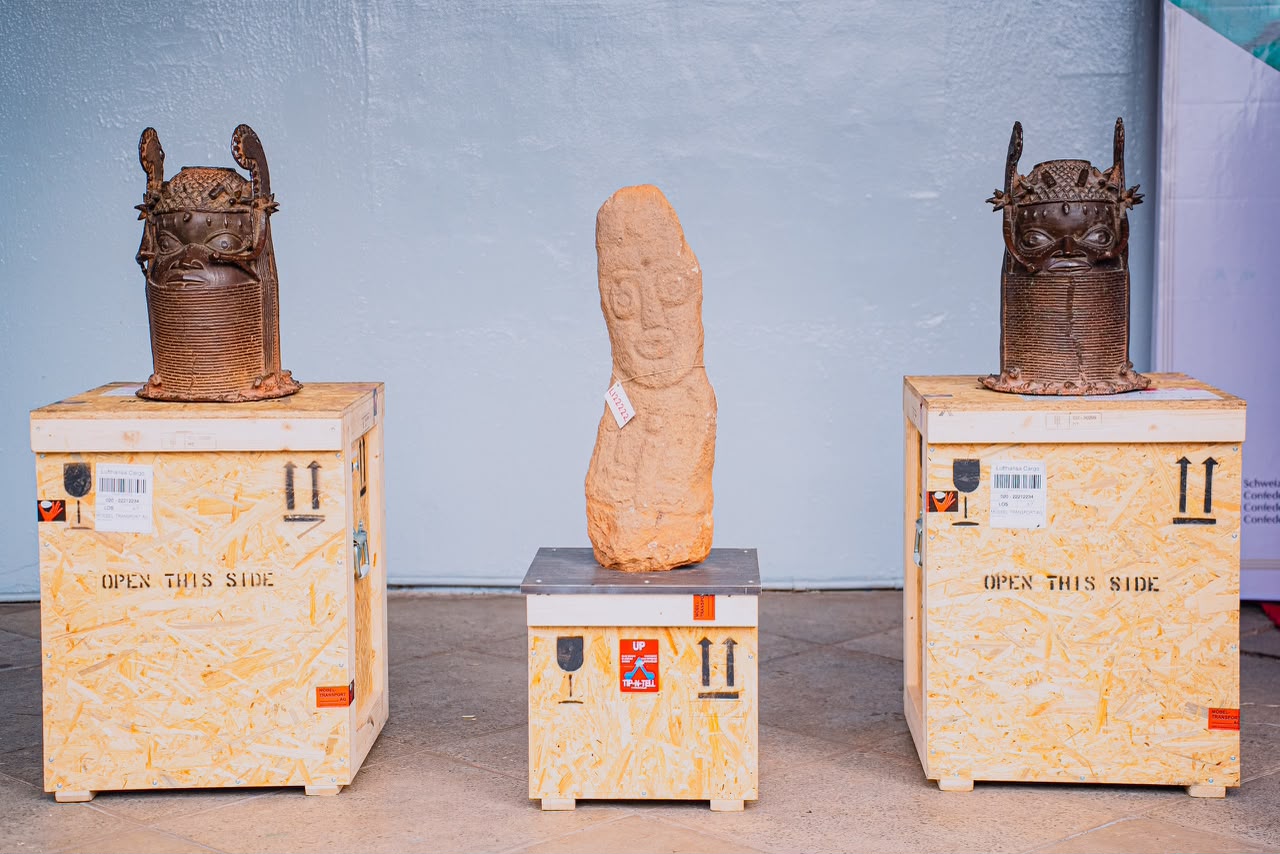
Switzerland's return of eighteen Benin Bronzes and four Ikom monoliths is a milestone in a restitution movement that is starting to outpace the institutions meant to receive it.
8 mins
Editorials
Dianna Offor, nicknamed "God's Artist," is a Nigerian-born visual artist, whose work is dedicated to expressing the essence of God and importance of faith in todays society. Currently living in Ireland–where she recently acquired a diploma in studio art painting, Offor has spent the last three years depicting the theme of Hope and Love through her biblical abstract paintings.
13 Mins Read

Editorials
Last week, Art Report Africa served as the official media partner for New Narratives and Singular Communication in Arts Journalism: The Museo del Prado Experience — a two-day international workshop held at the Yemisi Shyllon Museum of Art, Pan-Atlantic University, Lagos, organised in partnership with the Embassy of Spain in Nigeria and Casa África through its #PeriodismoÁfrica programme.
2 Mins Read

Editorials
On 14 June 2026, the Obama Presidential Center unveiled "The Obamas: Springing Forth" — a large-scale work by Njideka Akunyili Crosby, rendered in acrylic, coloured pencils, charcoal, and transfers on paper, measuring 108 by 120 inches. It now hangs in the Hope and Change Lobby of the museum's main building, free and open to the public, before the Centre's official grand opening on Juneteenth. It is the first official portrait of the former President and First Lady together.
3 Mins Read

Editorials
The 2026 Venice Biennale is, on paper, the most African edition in the exhibition's 131-year history. But what does that actually mean — and who does it serve?
5 Mins Read

Editorials
The Pavilion of Zimbabwe announces its participation in the 61st International Art Exhibition of La Biennale di Venezia, opening in April 2026 under the artistic direction of Adriano Pedrosa and the central exhibition In Minor Keys.
2 Mins Read

Editorials
There's a voice that lives inside us, often waiting in silence. It's a part of ourselves that we sometimes bury, a quiet shadow that only finds expression when we allow it to. Yusuff Aina's latest character, "Voied," is a compelling new light for this hidden self.
3 Mins Read

Editorials
In response to a growing chorus in the global art world declaring that “Black figuration is over,” O’DA Art Gallery’s latest exhibition, Black Figuration is Alive and Well, offers a firm and timely rebuttal. Bringing together a dynamic group of contemporary artists working across painting, sculpture, photography, collage, and digital media, the exhibition argues for figuration not as trend or aesthetic repetition, but as a vital language of presence, imagination, and agency.
2 Mins Read

Editorials
In the nuanced world of art collecting, the process is often as significant as the acquisition itself. Whether motivated by aesthetic appreciation, investment potential, or cultural enrichment, collectors must ensure that their decisions reflect both their personal values and long-term vision.
3 Mins Read

Editorials
For the first time in art market history, female African artists collectively surpassed their male counterparts in auction sales in 2023—a development initially dismissed as an anomaly. Yet, the trend persisted into 2024, with women artists securing a commanding 52.8% share of total African art sales.
3 Mins Read

Editorials
At a time when conversations about diversity, representation, and identity are more important than ever, Bozar’s latest exhibition When We See Us offers a powerful exploration into how we perceive ourselves and others.
1 Min Read

Editorials
Curated by Osei Bonsu, curator of international art at Tate Modern, and Cale Garrido, guest curator at the C/O Berlin Foundation, A World in Common presents twenty-three African and African diaspora artists from different generations and geographical contexts - with works by Kelani Abass, Atong Atem, Malala Andrialavidrazana, Edson Chagas, Kudzanai Chiurai, Rotimi Fani-Kayode, Maïmouna Guerresi, Hassan Hajjaj, Délio Jasse, Julianknxx, Samson Kambalu, Kiripi Katembo, Lebohang Kganye, Mário Macilau, Sabelo Mlangeni, Santu Mofokeng, Fabrice Monteiro, Aïda Muluneh, Wura-Natasha Ogunji, George Osodi, Dawit L. Petros, Zina Saro-Wiwa, and Khadija Saye.
2 Mins Read

Editorials
As September gets to its mid point, now is a good time to look at what October promises for the art world, with fairs and auctions spanning continents, spotlighting both emerging and established talent.
3 Mins Read

Editorials
Imagine growing up surrounded by art that wasn't just on the walls, but woven into the very fabric of Lagos. That was the world of Mrs Rayo Anthonio, daughter of the legendary Yusuf Grillo.Yusuf Grillo's story is one of dedication and quiet revolution.
5 Mins Read

Editorials
Anjola Awosika gives insight to his mission for this series: "I'm on a mission to unfold the vibrant African narrative through the lens of food and interior photography. I thrive on encapsulating the richness of our diverse culture in every shot, whether it's the savory essence of our cuisine or the allure of stunning interior spaces. Join me in this exhilarating journey at the core of my media agency, where we celebrate the beauty of African life through the captivating art of photography."
1 Min Read

Editorials
Debuting this month, Anjola Awosika announces "Ànjolá", an Interior Design project celebrating African culture in African homes. Looking at how functionality, comfort and Art coalesce in living spaces, Awosika is determined to document the intricate details that contribute to the beauty of specific African homes.
1 Min Read