
In Conversation
In conversation with Gabriel Selassie Tsagli
Gabriel Selassie Tsagli left Ghana at eleven and lived in Germany for twenty-six years. He returned to Accra in 2024 and made the paintings in Son of Kafui—his first proper solo exhibition at home—in a single stretch between February and this summer. He does not use a colour palette, works on many canvases at once, and calls the show a graduation. This conversation was recorded in Accra in August 2026 and has been edited and condensed for length and clarity.
SHARE
6 Mins Read

ARA: Congratulations! This is your proper debut. You made these paintings after returning to Accra in 2024. What changed in the way you painted once Accra was physically around you, rather than something you remembered from Berlin?
GT: I made all the works for Son of Kafui this year, from February to now, and before that about a year just moving around, looking at things, taking pictures. Also accepting myself for the way I see things. The truth is, I’m raised multicontinental, so it’s tough to lose yourself in that. I think it’s something you just have to accept for what it is, and be grateful for the journey you have. I don’t think it’s about mixing stuff. I think you’ve just learned your way of creating differently, and embodied it for yourself. I’ve always said showing that crowd feels like a graduation. I’d rather be judged from home than anywhere else. So that’s the energy I try to work with in these paintings: not letting home influence who I naturally am, but adding on to what I’ve become.
ARA: How do you describe working from Africa, in Africa, as a deliberate choice rather than simply a return? You decided it was time to leave Berlin. What are you choosing when you choose to work here?
GT: It’s a different approach on energy and work. It’s easier for people to call you a Black artist in Europe. Here, I’m just an artist, or I’m just home. It doesn’t even have to be the word “artist.” I grew up with my aunties here when I was young, and I lived in Germany for twenty-six years.
ARA: From when you were eleven?
GT: Yeah. So they always ask themselves — what is he doing, how is he doing. A lot of artists have parents here who don’t know much about art yet but hear a lot about it, and for me the most important thing was to do a show where my aunties and family could come, and not have to fly to Europe to see it. We’re all close to each other. Communal is a great word for it.
ARA: It flattens things too much to call it a homecoming show. What’s more interesting is that you came back before graduation, in your terms. So, graduation from what, and into what?
GT: I didn’t study. I just enjoy creating something, doing something with my time, observing, and self-reflecting a lot. So if I say graduation, it’s a self-reflective term: do the memories I had from Berlin make sense when I’m here? How do they affect the work from here — the longing you have for home — how does it feel when you’re actually home? Is it still longing, or is it an arrival? I don’t even feel there’s anywhere to arrive, because when you’re home, you’re just home. That’s why I like the term graduation: also because a lot of artists here I look up to are closer now.
ARA: Any names?
GT: I enjoy Kaloki a lot. Amoako Boafo. Daniel Kashi, Teresa — so many artists I really look up to here who are closer to you when you’re home, because everybody understands the gratitude of the journey. It’s easy now to go to Ibrahim Mahama in Tamale and be inspired by his work. I’ve never done that before, but it’s possible now. Or Almighty God — his work is also very close. All my references are closer. It feels like a natural thing, given what I went through in Europe. For me, Ghana has always been the place to go back to, and creating from Africa feels more purposeful than creating from Europe.
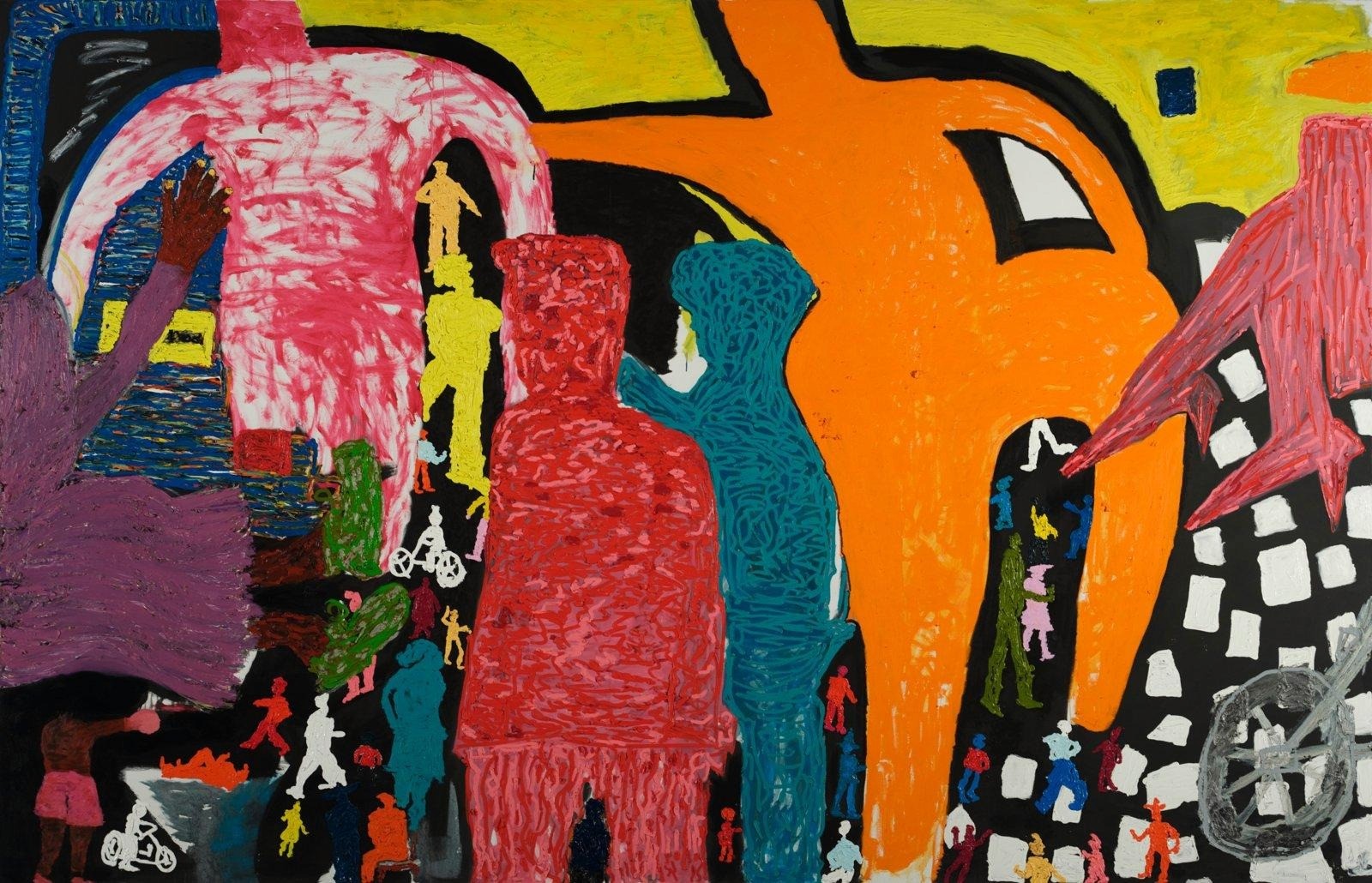
ARA: Let me narrow to one work, starting with Rave. How much has being in Accra changed the work you make? It’s easy to assume the colours are more intensified. Are they, though?
GT: I still don’t use a colour palette. I never have. I like working with what I have from the place, the colours that are physically available in the country: there’s an economics to it. Seven tubes, and I can mix any other colour from those, which makes it easier for me not to overthink when I’m working. Just colours on the table. I like working on a lot of canvases at the same time, and I trust my intuition to pick a colour. I might be working on one painting, but the colour I picked is actually meant for another. It’s a dance with the room, communicating with all the pieces at once. A lot of my work has to do with movement. Most of the time I’m turning, picking a colour, moving to the next canvas, because in my mind I’ve mapped out what’s going on, even though a lot of it happens intuitively. I don’t force a colour onto a painting. If it’s not meant for that painting, it won’t stay there. I have a lot of patience; I know when to rest from a painting and diversify the movement instead.
ARA: Moving on to Blue notes: a grand piano in the sea, hands flailing at the bottom, and it’s unclear whether the figures are enjoying swimming or flailing for their lives. It reads almost as the opposite of Rave — no figures, more like a study of a mind. Before I over-interpret it, what’s happening in this painting?
GT: Something triggered art in me. There was a moment I decided to do this because nothing else calmed my mind. I feel like it’s the same with jazz, with blue notes — and it hurts to say, but without slavery there wouldn’t be blues for a lot of Americans. From farm work, people started making music to carry the pain of their lives, and I find that very metaphorical for a lot of things in my own life. There was a point where I got fed up with what society considers “normal” — the kind of work our parents want for us. I used to believe in that, but there was a point where it made sense to do something for no special reason. It just made me happy, made me more mentally observant of myself, reaching for something without it needing to be a goal. Maybe it’s the doing, the stretching, that fulfils me. I like that there’s a gap between the goal and the hand. The hand might be almost touching the piano, but there’s still that gap, that enormous potential to learn and grow, that space to be reflective about your own pain, or society’s pain.
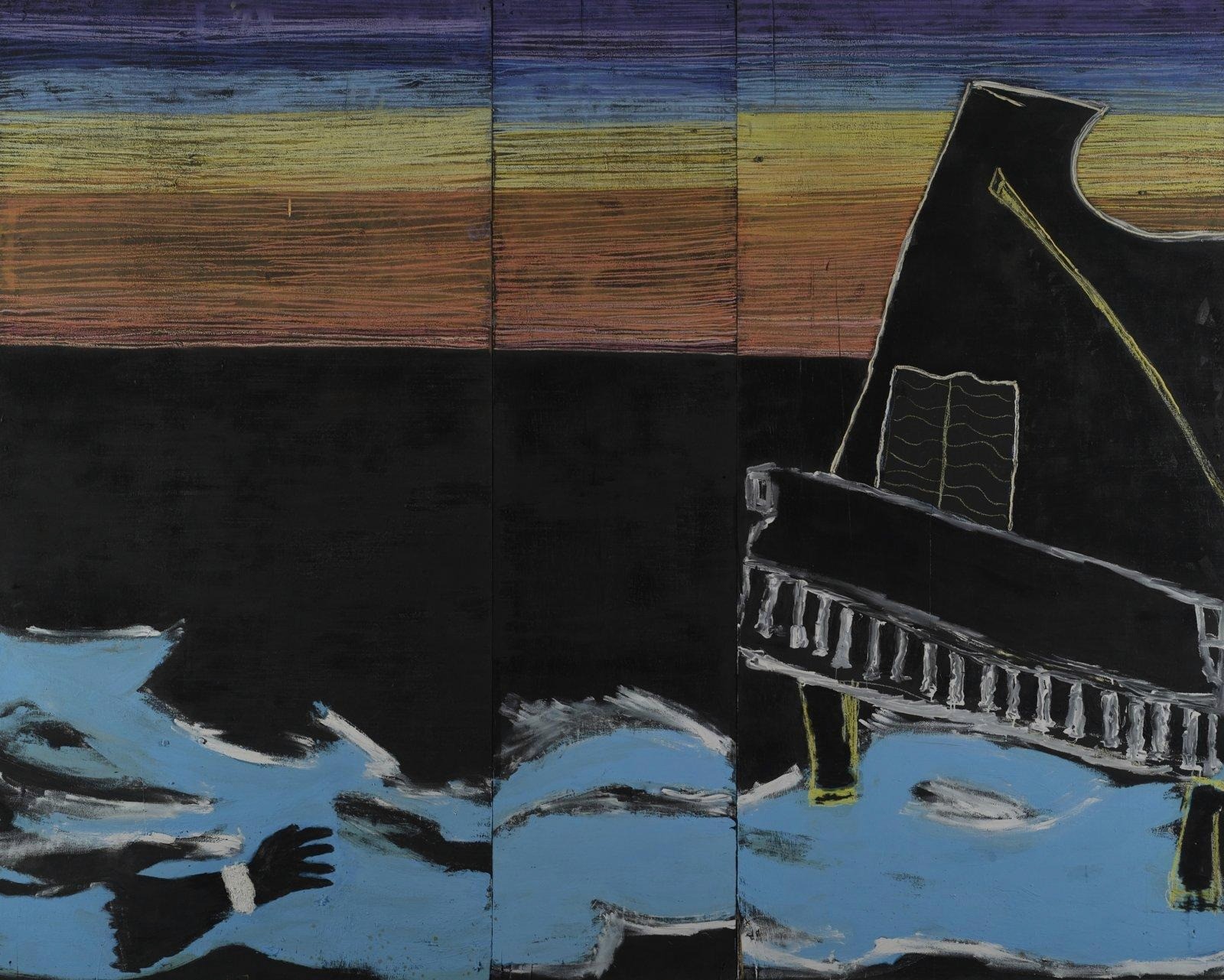
ARA: It reads as an intensely psychological painting. I keep re-ordering the picture in my mind, wondering: if that grand piano were front and centre instead of off-centre, would it hit the same way? Is it the most consequential painting in the show, psychologically?
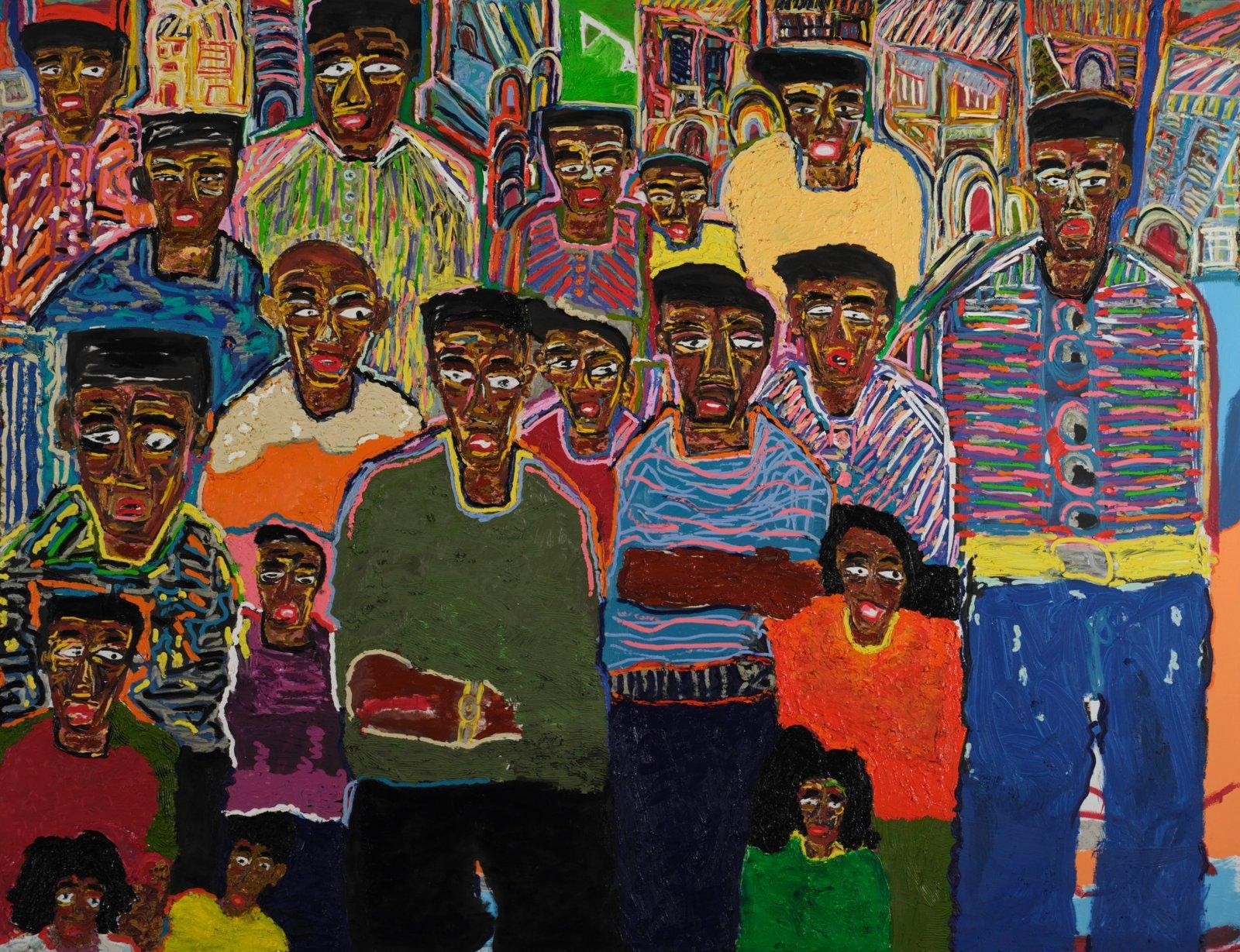
GT: Maybe, yes. But it depends on the moment you’re in, as a viewer and as a maker. There’s a lot of intensity in the room, down to the smallest work, which carries a calmer energy against everything else going on. It always feels like you’re fighting and answering different questions raised across different spaces — some about you, some about friends, some about people who inspired you, like the last work on the right, El Anatsui’s wood installation called Group Photo. That captures what triggered the Blues painting for me — researching people I admire, seeing a wooden “group photo” piece, which fed the thought behind the next painting: without slavery there wouldn’t be blues. Very controversial thoughts, sometimes. Next to it is the painting that reflects most of the exhibition Son of Kafui. My mother’s name is Kafui; my daughter’s name is Kafui. When my mom passed, I went into a deep depression, until I understood it was really about resting deeply and knowing how to handle your days. It is also about breaking down words. If people ask what I miss most, I always say my mom, and music. The word “blues” carries a sad tone but somehow still gives strength. So what came out of this painting is the idea of longing and missing, but it doesn’t have to be brutal, even if the reality behind it is. What you carry out of it has to be a sense of calmness in the missing.
ARA: It struck me as almost a continuation of Edvard Munch’s The Scream (1893), if you tilt the point of view: from the screaming figure with hands on his face to what was really behind him. To what extent do you care about allusions to the canon, European or African, when you’re making work?
GT: I don’t feel like anybody is ever producing entirely new work. We’re always referencing, even without knowing it. I’m aware I’m referencing, because knowledge comes from someone. Growing up, I knew which museum was in which city, and the best teacher for me was different spaces that gave me peace of mind to look at work. I didn’t study formally. There’s always a fight about African countries needing more museums, because it opens things up in a kid, lets you appreciate textures across different eras. It’s tougher to look at African art in Europe, because it sits in glass boxes, looted. It doesn’t look good enough waiting there for someone to come pick it up.
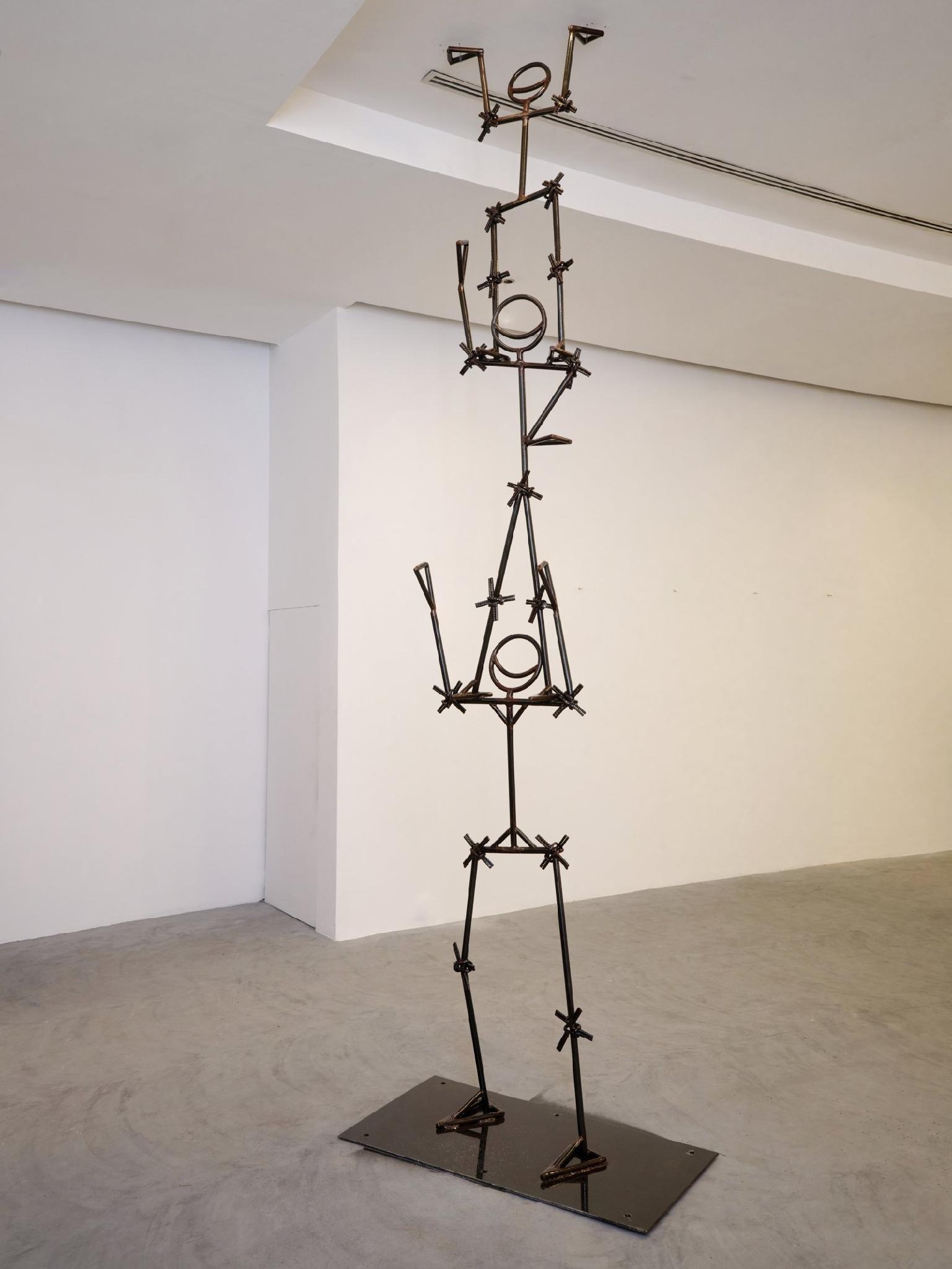
ARA: The third key work is the sculpture, Salvation. Different traditions create a god or deity in stacked, cylindrical, vertical form. Why make this work, and why structure it around yourself and your daughter?
GT: If I had a totem, it would be family. Going back to Blues, the idea of missing a family when you’re far from home, and then building your own family, and the first decision being: let me go back to where I come from and grow with this family there. It’s interesting to live somewhere for twenty-six years and come home. You realise how much you don’t know. You think you’re African; in Europe you’re Ghanaian; and then you’re back and you have to learn Ghana all over again. What helped me through the last few years was my family. I believe in holding it down for my daughter, so she can hold it down for her kids. Putting the work into yourself so the next generation has some reflection to draw on. I’m carrying my daughter right now, but I’m also learning from where she stands on my shoulders.
ARA: How would you define an artist?
GT: I don’t really see myself as an artist. I think the artist is the one most dedicated to spending time on their craft. It can’t just be about being a painter, it has to connect spiritually as much as materially, as an experience. It has to feel like a universal language; it’s about finding your own way of communicating. I wake up every morning, do acupuncture on myself, lie down for twenty minutes, write three pages, and read three pages of any text I’m interested in. That consistency and structure is what makes me want to spend time in the studio. I don’t walk around feeling like I have the answers, but I believe an artist is someone consistently dedicated to their craft, building structure around that. And by that definition, farming is also an art.
ARA: So a farmer can also be an artist?
GT: It depends but that’s why I said dedication. How dedicated are you to what you’re doing? Are you the kind of farmer who uses pesticides, or the kind dedicated to not using them? I believe that in my grandmothers and grandfathers too. It doesn’t feel complicated for me to believe in that. I feel like I know God. I don’t “believe” in God the way you’d believe in something intangible, because I know I’m actually waking up every day, meeting new people, sitting here doing an interview. I know there’s something good happening with my karma, because I’m also putting good out. I really believe that the idea of dedication applies as much to farming as to law, numbers, physics, anywhere. It’s about how much you care about your dedication.
ARA: How would you define art?
GT: Breath. [laughs] I don’t know if it needs a definition. I just know it has to trigger a surprise, has to be questionable. I don’t know if it needs to be defined, but I know it can make a feeling happen, or a conversation happen.
ARA: The definition I keep returning to is Alfred Gell’s idea of art as a “technology of enchantment”: that the magic lies in the gap between the artist’s intention and the uncertainties they have to overcome in making the work. Which circles back to what you’ve been saying about dedication, about the doing.
GT: That’s the doing, yeah.
Son of Kafui is at Gallery 1957, Kempinski Hotel, Accra.
more stories
In Conversation
In his first solo exhibition in Ghana, Frank Coffie builds paintings backwards — yarn first, paint last — from family memory, discarded fabric and pain.
8 mins Read

In Conversation
In When the Center Holds, the Nigerian artist speaks with Sabo Kpade about suspension, memory, postcolonial thought, colour and why drawing becomes an x-ray into painting.
6 Mins Read

In Conversation
The painter on returning to Accra, colliding London with Obuasi, and why she lets a painting go above 90 percent.
8 Mins Read

In Conversation
Recorded at ARAMI, Lagos, during a press preview for Pure Water, Chika Idu’s solo exhibition with SMO Contemporary Art. In conversation with Sunshine Alaibe, Idu traces water through childhood drought, environmental precarity, the Atlantic slave trade and the changing representation of women in his work. By Sunshine Alaibe Edited by Sabo Kpade 17 September 2026. This conversation has been condensed, reordered and edited for clarity.
10 Mins Read

In Conversation
Orry Shenjobi on her Venice residency: raffia craftwork, studio life, and what she learned — with takeaways for artists eyeing their own residency.
4 Mins Read

In Conversation
Ralph Waldo Emerson, in his essay "Society and Solitude," wrote, "We do not believe our own thought; we must serve somebody; we must quote somebody; we dote on the old and the distant; we are tickled by great names; we quote their opinions; we cite their laws." For Ikechukwu Nduka, he stands as the antithesis of the society Emerson critiques. He defied societal expectations and familial disapproval to pursue his passion for art, successfully contending the dependence on the opinions of others. "They say art is therapy, but while creative minds like us are creating this 'therapy', I think we need it the most, or rather we need it first." He aptly expressed the stark pressure.
7 Mins Read

In Conversation
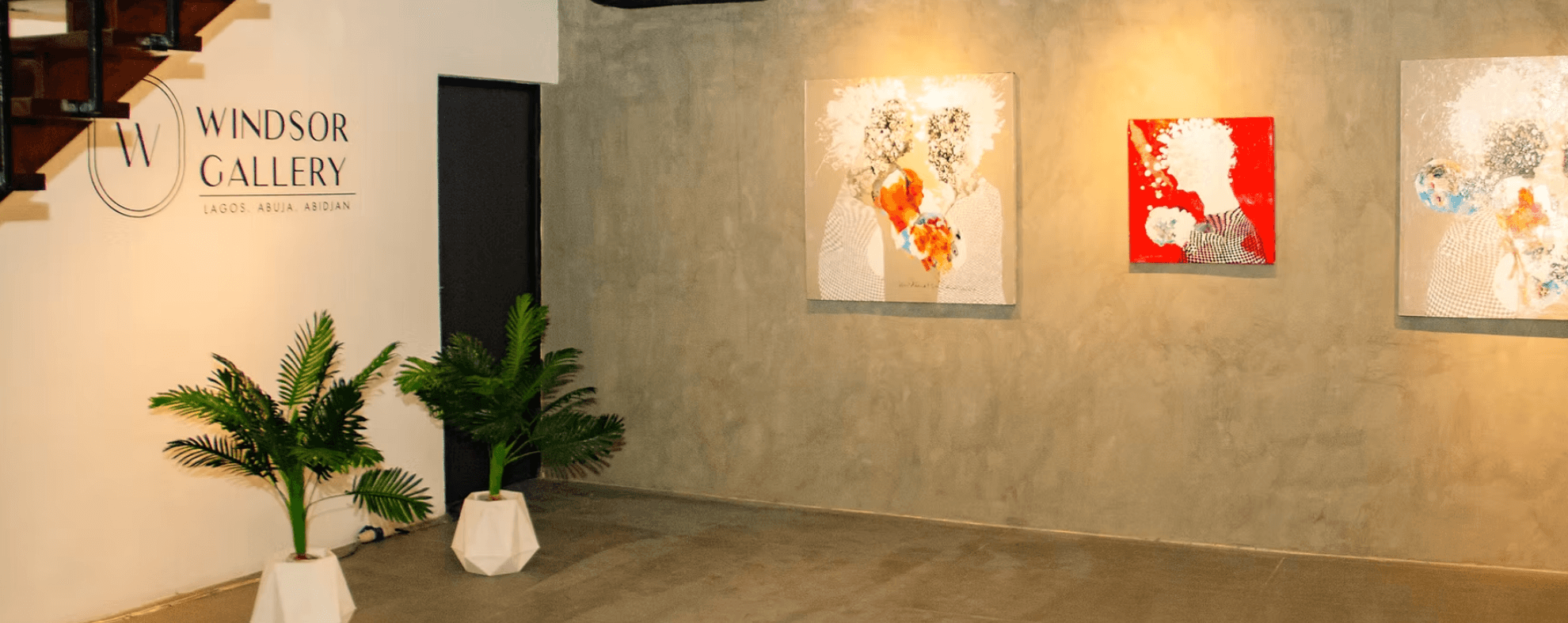
Windsor Gallery is becoming a prominent player in the West African art scene, expanding its influence from Lagos to Abuja and Abidjan in just a few short years. This growth signals not only the gallery's ambition but also its commitment to creating a platform for contemporary African art.
6 Mins Read
In Conversation
In Ethiopia, women vendors are often overlooked and marginalized, despite being the backbone of the market. Their struggles are perpetuated by societal perceptions of their stature. Challenging these norms, Tadesse Mesfin's solo exhibition, "Where We Coalesce," currently on view at Addis Fine Art (until November 30, 2024), seeks to reframe the narrative surrounding Ethiopian women.
5 Mins Read

In Conversation
In the midst of shifting societal norms and increasing complexity around identity, "Freedom in Multitudes" asks important questions about Black and African identity. Through the work of nine international artists, this 1897 Gallery exhibition explores the nuances of self-expression.
5 Mins Read

In Conversation
On this podcast, we delve into the stories of Key Industry Players in different art ecosystems on the African continent. We speak to Gallerists, Art Historians, Curators, Advisors & Art Directors to get insight on their markets domestically.
1 Min Read

In Conversation
Within Nigeria’s creative scene, Olufisayo Bakare stands as a multifaceted force. Born in Lagos to a family with a rich art and design heritage, her interests took her through the intricacies of various industries. From aspiring artist to entrepreneur and curator, Olufisayo is the visionary behind the brand, interior Living (Intlvng) and The Yellow of Lagos.
7 Mins Read