In Conversation
For Chika Idu, Water Holds Memory—and the Possibility of Freedom
Recorded at ARAMI, Lagos, during a press preview for Pure Water, Chika Idu’s solo exhibition with SMO Contemporary Art. In conversation with Sunshine Alaibe, Idu traces water through childhood drought, environmental precarity, the Atlantic slave trade and the changing representation of women in his work. By Sunshine Alaibe Edited by Sabo Kpade 17 September 2026. This conversation has been condensed, reordered and edited for clarity.
SHARE

8mins
The title Pure Water suggests a pristine world, but the show is more layered than that. You have used water as your storytelling engine for a long time. Where did that begin?
Water has played a very important role in my growing up. I come from a village of drought, where the water we use is gathered by rain. You create these channels on your roof and then it all runs into a dug well, and you have to manage it. The nearest stream is a very far distance away and it’s also unpredictable, because you can get there one day and discover that it has all dried up. And it is the assignment of the children to go and get water. Then, coming to Lagos, there was the problem of carrying buckets on our heads, going three streets away looking for water. So the issue of water has always been there.
“Pure water” means different things to different people. In Nigeria, when you mention “pure water”, our minds go to sachet water, which has a history of its own. Our minds do not necessarily go to clean water. Outside the country, people think of clean, treated water. So my story of water will always be different depending on who I am telling it to.
When I had the experience of children bathing in what I described as “polluted water”, people who had grown up in the same environment later attacked me online because I kept writing about it. They grew up in that environment and they are okay and doing very well. So they didn’t see why somebody like me, who does not really know their story in depth, should criticise their livelihood. It started from there.
On my trip to France, I heard several times that Black people are afraid of water. “Black people can’t swim. Black people are afraid of water.” And they said it as a matter of fact.
And then I also had the experience in Martinique. I saw these statues, and the statues were bent, all leaning towards the ocean. When I inquired what this was about, they said the captives who died when the ship bringing them to the area was wrecked were buried near the shore, while the slave traders—the white people who died—were buried in the cemetery. So all these things, and again the history and stories related to the transatlantic slave trade, came together.
[Idu is referring to Cap 110, Laurent Valère’s 1998 memorial at Anse Caffard, Le Diamant.—Ed.]
You have spoken with a psychologist who looked at your work across time. There is a protectiveness in how you treat your subjects. What led you to children?
When we have experiences, a lot of this information is stored up in what we call the soul of man. And a lot of the things that we do subconsciously, without us really intending to, those past experiences play out in the way we find ourselves acting.
So a lot of the things that I experienced as a child, as an adult painter, I was going back to my childhood, sort of, and trying to correct some things. Not really intentionally, but going back and trying to correct things, trying to draw attention to some things that needed attention.
As a child, I was abused. I was sexually abused as a child.
And because I also have a forum of young adults that I mentor, by the time I spoke with them about such issues, I found that almost all of them—about 95 per cent of the young adults I spoke with in that forum—said they had also been abused, both male and female. It was shocking. When I saw the depth of it, I invited professionals to help.
So a lot of what I found myself doing was a response to things I had experienced, and to things people around me had experienced. I would not say I was responding late, but I was responding at the time that I was able to respond.
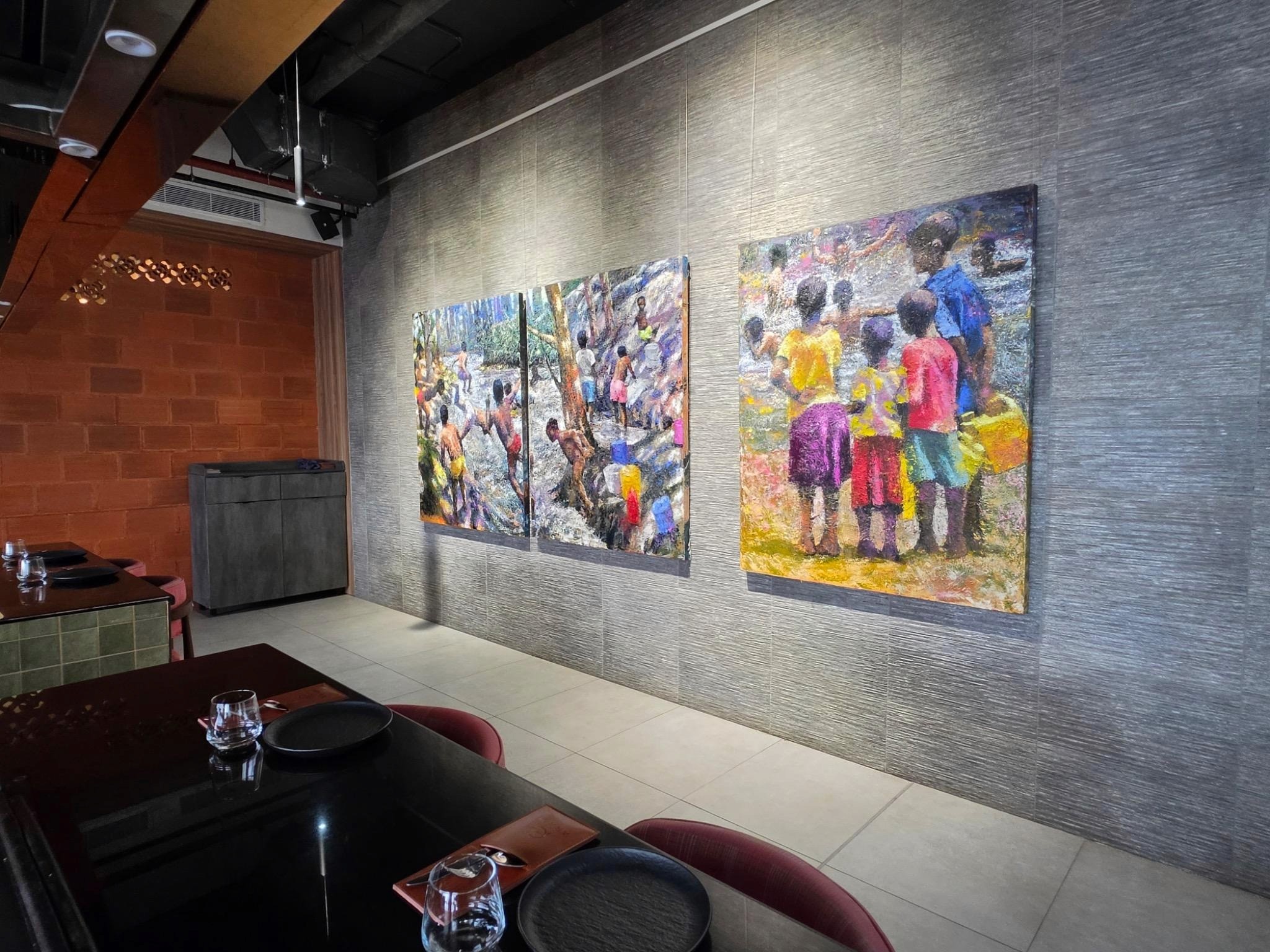
So I tried, through my work, to draw attention to kids in a happy environment. I always found myself taking the sadness and creating something happy — creating an environment where there is joy. So I kept on painting kids, playing kids that were having a good time. Kids that were discovering, because kids are very dynamic. So I reflected on this time and created situations where kids were happy, and sort of pulled the blanket over the sadness that I, and I know a lot of other people too, had experienced as children.
Two works here are more direct—The Assembly and The boy named Happy. You connected them to reports of schoolchildren being kidnapped in Nigeria and to the phrase “soft targets”. What was happening in the studio?
When I was preparing for this show, it was not really my intention to paint the children. I wanted to focus on the swimmers because there is a message behind that. But in the process, reports came of children being kidnapped from their homes and taken into the bush, where they spent a long time. It was very touching.
And then the politicians and the soldiers, when they give their reports, they say that the terrorists are focusing on “soft targets”. And I found that phrase to be very disturbing. “Soft targets”, which of course means women and children — targets that cannot defend themselves. They are vulnerable.
So I had to stop the work towards the exhibition, and I had to respond. It became a burden in the studio. If there is something I need to speak about through my work and I don’t, it becomes stuffy until it is done. So I had to stop everything and create those two paintings.
The boy named Happy is a drawing and the first of its kind in my practice. It is a mixed-media work incorporating newspaper collage. I didn’t have newspapers in the studio, so I had to go and get them because I needed to do this on what I call “the issues”. If you look at the drawing, you see that there are a lot of strokes. There is a lot of pain. There is a lot of struggle. So it had to be done on newspaper.
It’s like saying the issues that affect the child, they are in him. They are around him. Like they say, when two elephants fight, the grass suffers, because the grass cannot get away. The grass is trapped; it cannot go anywhere.
Everything is politics. And we have grown men playing politics and endangering the future. Because the children are the future, and when they are affected by these issues, the future is going to reflect what is going on now. So that is why I chose to draw them on a newspaper.
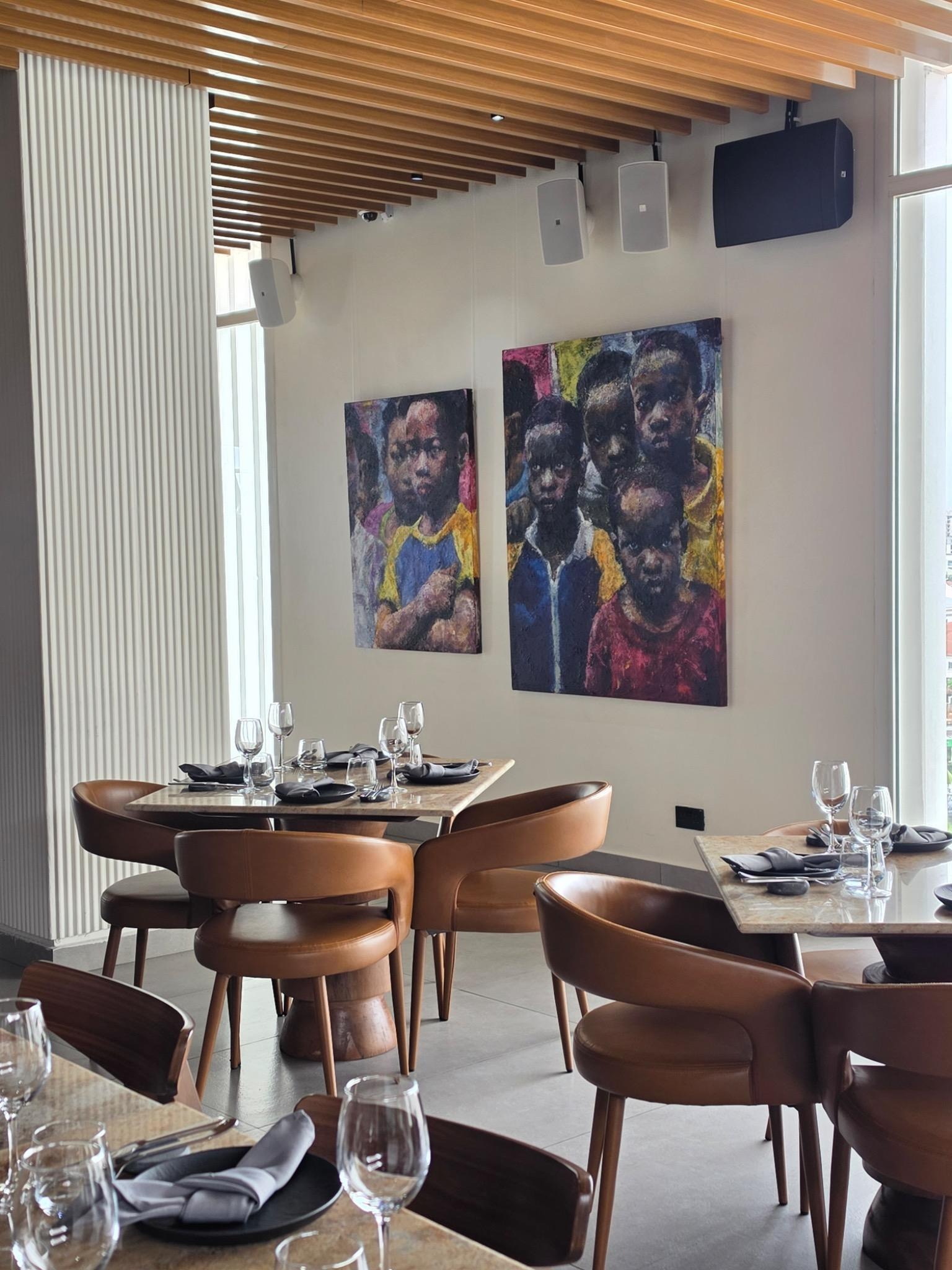
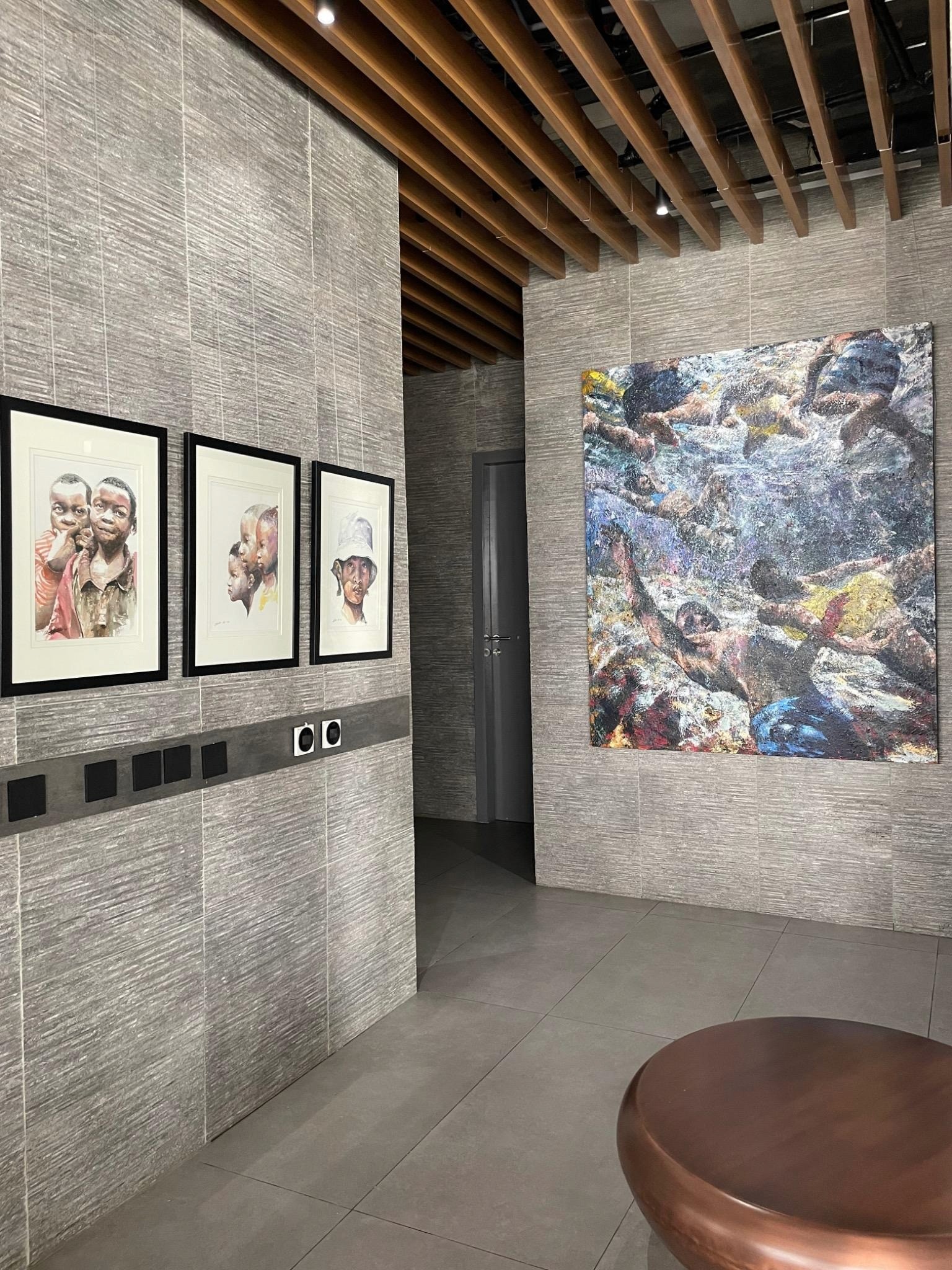
Your experience in Martinique led you to the history of Igbo Landing. At O’DA Art’s Into the Deep, the children in the water were joyous; here, the swimmers seem to surrender themselves more fully to the current. How did that history enter the work?
In my study of history, because the experience in Martinique opened the door to a lot of other things, I became very curious about the transatlantic slave trade. Then that experience in Martinique also led me to the discovery of Igbo Landing.
I had to understand that these people had once been free. Some may have been of noble birth and may not have experienced hard labour before their capture. Many Igbo communities historically had decentralised systems of government rather than kings. Igbo people were very free-spirited. And then here they were being transported as slaves, and they would rather die than see themselves in that predicament. According to the story, they chose death rather than enslavement.
There were also slaves who drowned or died from being seasick, taken from the hinterland, where some had never seen the kind of body of water that they saw when they came to the shore. They saw the Atlantic. They were used to streams and small ponds or rivers. So a lot of them died at sea. Then the bodies were thrown overboard.
Anytime we talk about these stories, we get angry. But if you dwell on the negative, whatever your mind dwells on multiplies. So if you keep focusing on the anger of what happened to the slaves, you just keep getting angry, and there is nothing you can do about it.
So what I did was, I saw myself as one who would set them free. By painting them swimming and being one with the element of water, without shackles, without sorrow, but giving them a joyous atmosphere, I see myself as contributing to their freedom. And I also gave them a new environment, where there is no more sorrow, there is no more pain, and there is no fear.
So this is why you see that my swimmers, it’s like they are alive underwater. They are free. They are having fun. It has become their environment.
For a long time, you painted women with their eyes closed, and only recently have you begun to paint them with their eyes open. What prompted that shift?
When I have conversations with my mom, there are lots of stories about things that she went through in her marriage, in her home. When she tells these things, you get really angry. And a lot of the time people are around these things happening, and nobody does anything. Nobody renders help. So that is part of the foundation.
And then there are the issues we see every day. Religion, culture, tradition. Women are expected, like trophies, if you can use that word, to be seen, to make the place look beautiful, but their opinions are not sought. There are lots of issues, not just in Nigeria, but globally — cultures and traditions that regulate women and do not allow them the freedom and equality that is theirs. It’s funny that they have to fight for these things. We have very, very intelligent women in society, but we expect them to be silent. Especially in religious circles.
The mask spoke to identity: how a woman is expected to become somebody else in order to blend in. When a woman goes to church or to the mosque, she is supposed to become a particular character in that environment. A woman is expected to dress in a certain way and also speak in a certain way. All these issues informed me when I started painting women wearing masks.
And what I was doing was, I started painting women taking off the mask. I was telling them, “Look, that is no longer necessary now.”
So I started also painting women with their eyes closed, which also spoke to: you are not expected to observe. Because what you see, you speak. So you are not expected to see anything. You can be here, but close your eyes.
But recently, I started painting women with open eyes. It says that that time is gone. We are in this era now. So if you’re still closing your eyes, open your eyes.
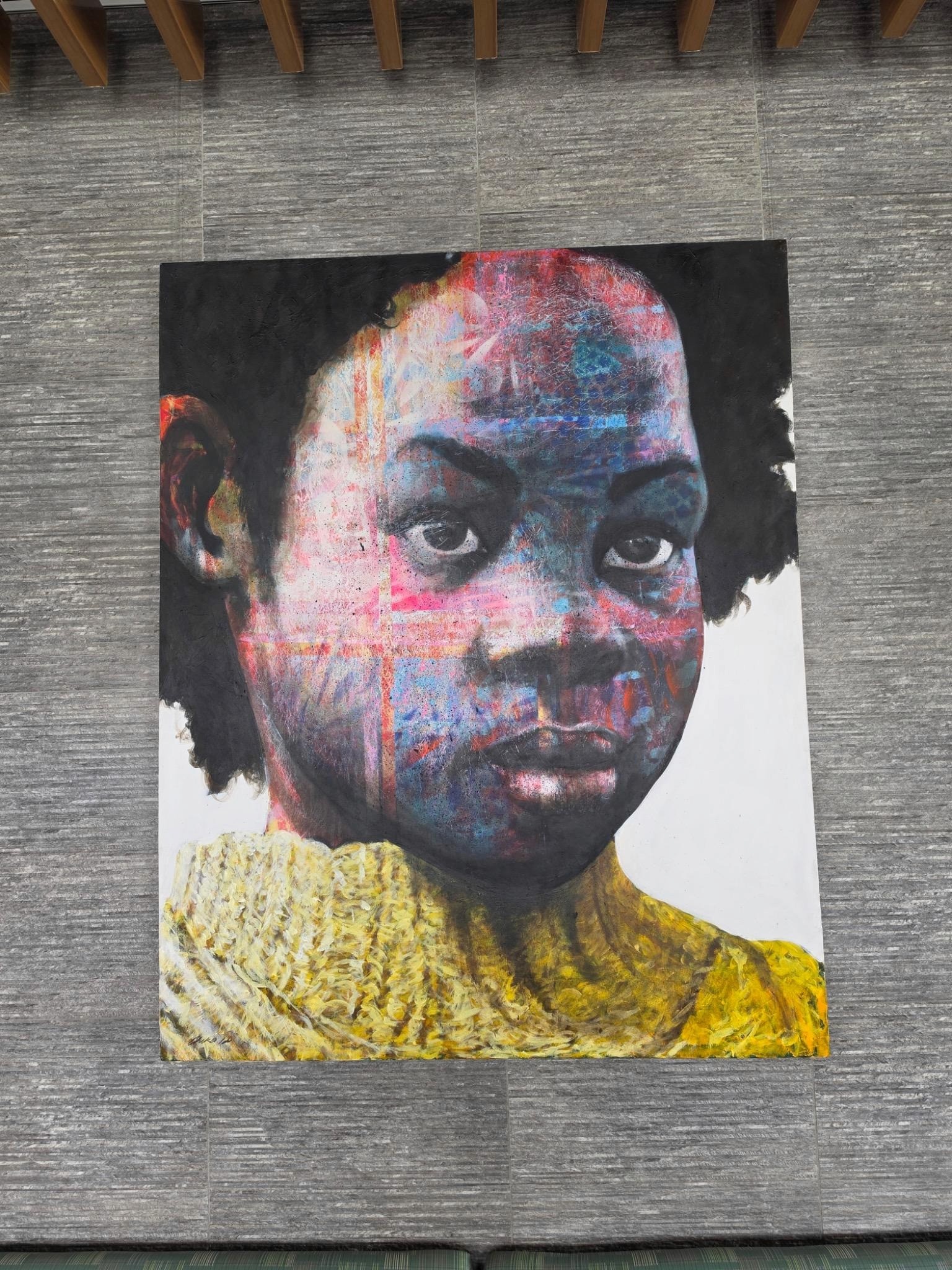
The women and girls carry more colour and definition than the watercolours behind us. Why not use one stylistic language across the show?
When I paint in oil, I call this style “Light Against Visual Distortion”. I try to create the character of light and how light behaves around solid elements that distort our vision. For this I use only palette knives.
The acrylic works are where you see the paintings of women. I knew that with oil people would get carried away and not get the message, so I experimented with acrylic. But I always want to use materials differently from the conventional. I use rulers. I use toothbrushes. I use hard brushes. I use brooms. I use ropes. I use nylon.
And then the watercolour technique is also very different. In my own practice, I began leaving areas of the watercolour paper blank at a time when the approach I had been taught was to cover the whole sheet. I was quite young then, so I played with multidimensional effects—crazy things.
The room where I paint oil is different from the room where I paint acrylic. When I walk into a room, I feel the energy for that medium. This is very important for me.
The music is different too. For watercolours, I listen to classical music. Acrylic is close to oil, so I need rock music. I listen to a lot of rock — and I apologise to my neighbours. It gets me in the mood. It helps me to forget the world around me. I’m alone. So it does that for me.
What is your advice to artists who want to take on themes this difficult?
Our work is a response to something, or it is trying to draw attention to something. If the burden is in us, and you feel like you have something to say, you need to say it. You need to say it with your work. If you can write, you should also produce text to support your practice. It’s very important. And I’ll tell you, when you do that, you’ll feel the lightness. You can sleep at night. Or else it’s just hanging there.
It’s like you gear up for a fight, and then you get in front of the person, and the size of the person makes you back down. You end up not saying what you wished to say. Then you go home angry with yourself. “Why didn’t I? Why did I go back?” Now it’s late. It’s the same thing with my work.
I paint every day. I know some people paint maybe 10 paintings in a year. Good for you. But if I can paint 20 works in a month and I paint five, I have the mind to do more. So I need to let it out. It is there. I need to give it to the world.
So every artist has a role to play, to contribute to the library — the library of the world — with their work. This is what we are called to do. If we do not do it, it is a failure on our part.
Imagine if Van Gogh had not died when he died. Imagine how much more he would have given. So we bear this burden, and we need to work and work and work. Close our doors and produce.
Chika Idu, Pure Water, SMO Contemporary Art at ARAMI, Lagos, 5 September – 30 November 2026.
more stories