
In Conversation
Luke Agada: 'We leave our memories in colour'
In When the Center Holds, the Nigerian artist speaks with Sabo Kpade about suspension, memory, postcolonial thought, colour and why drawing becomes an x-ray into painting.
SHARE
6 Mins Read

Luke Agada's first solo exhibition with Sean Kelly, When the Center Holds, brings together four oil paintings and four charcoal works made in 2026. Across the exhibition, bodies, furniture and architecture remain legible just long enough to become unstable; forms stretch, shear and recombine inside spaces that behave as much like memory as fixed place. The exhibition runs at Sean Kelly, New York, from 11 September to 31 October 2026.
ARA: The title is now When the Center Holds; it changed from Stasis. Briefly, can you tell me why the change?
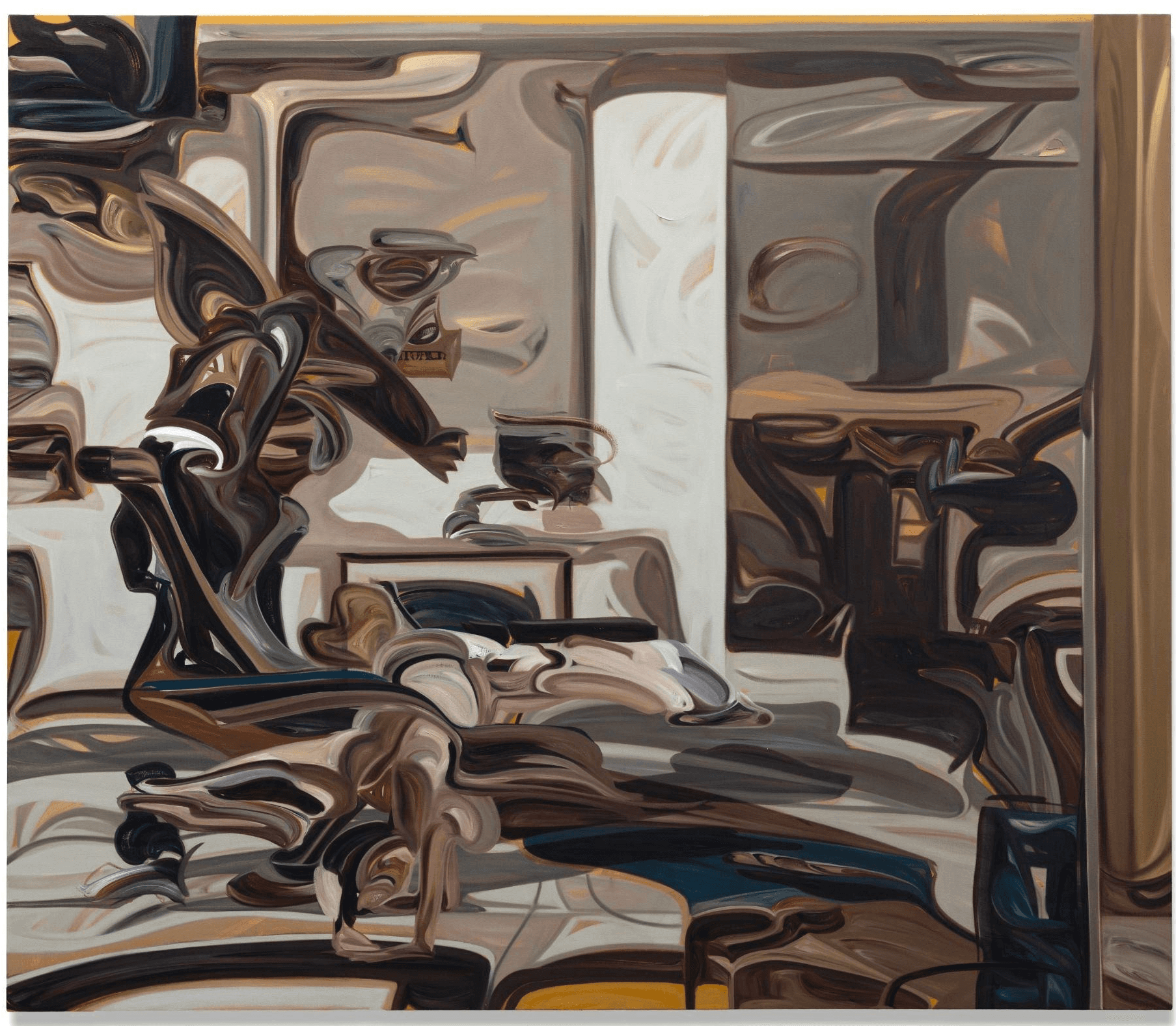
LA: Stasis is a moment of unstable equilibrium — the moment between something falling apart and continuing to hold, or being reinforced. It is when nothing is happening, so to say, but within that state of pause there is a lot of tension and expectation because it is a moment of transition. It was my contemplation about the times we are in right now. If we pay enough attention, we inevitably notice the shift in the world order, whether economically or geographically. It feels like everything is almost at a standstill. You are waiting for things to fall apart or to get better. Something has to give. The exhibition started from there, as a way for me to find an outlet to express that state of mind. Then it shifted to When the Center Holds. I began to think that sometimes, in order to understand the moment and perhaps predict the future, we need to look back at where we are coming from. Time itself can be quite cyclical. I was reading W. B. Yeats's The Second Coming and that proposition that 'the centre cannot hold.' To him, that was an image of a world in which established structures were breaking down and things were moving towards disorder. But I did not want simply to reproduce that pessimism or accept collapse as the inevitable conclusion. I became more interested in turning that proposition around and asking what enables the centre to endure. I also thought about Chinua Achebe's Things Fall Apart. By the centre, I do not mean a fixed geographical, political or institutional centre. I am thinking about something much more relational: memory, relationships, a sense of belonging, the capacity to adapt. The centre in that sense is not something permanent. It is constantly changing, continuously reconstructed. Part of the reason I shifted from Stasis is that I refused to see suspension as a form of paralysis, or simply as being stuck between one condition and another. I think of it as a condition of becoming. Something can appear still while enormous forces are gathering and moving beneath the surface. The figures occupy that difficult interval where histories, identities and relationships are constantly being reorganised, where something may no longer entirely be what it was and can become something else — a hybrid of the old world and the new world.
ARA: Nothing seems settled to the eye in these paintings. Everything feels in flow — fragmented and whole, figurative and abstract, all at once. Is that kind of stored or arrested motion what you are after?
LA: When I think about painting, there are a lot of possibilities with painting. Painting gives me a way of thinking that is not completely verbal, a way of articulating thoughts that I cannot fully express with words. There are things I understand through making before I understand them intellectually. A painting can hold contradictory things at the same time. That is one thing that draws me to painting. It can be beautiful and unsettling. It can be fragmented and whole at the same time. It can be in and out. It can be forward and backward. It is not exactly figurative and it is not exactly abstract.
ARA: For the viewer, what helps the mind process all these elements so that they are not simply all over the place?
LA: I use elements like colour to create associations and enable the viewer to differentiate between things. Sometimes colours are used to tune some things up, to express a form of importance, or to tone them down, to relegate them to the background and reduce their immediacy, so that they are more like a subtext to the idea of the painting. It is not necessarily what should be in front of you immediately. I use colour to curate the viewing experience of the viewer. I also apply what I call dream logic. The part of surrealism that I truly appreciate is dream logic, because it allows you to do things that can only happen in a painting. I want the environment to feel familiar enough that you recognise something, but unfamiliar enough that you cannot completely locate yourself within it, because it is an in-between space. I adopted Homi Bhabha's idea of the third space, where many systems collide. It is a space of becoming, where something is neither here nor there, where there is ambiguity and hybridity. I do not want to give the viewer a fixed geography. The landscape is psychological as much as physical, somewhere between memory and imagination.
ARA: You mentioned these being landscapes. I don't see them as landscapes at all; I see them as intimate interiors, like spaces you know very well or recall from memory and are reimagining. What have I missed?
LA: I am glad you see them that way, because when you approach the painting at first it creates a sense of dissonance. You are not sure where you are, so you have to look closely. I appreciate the sense of close looking and slow looking. When you slow yourself down enough, you are almost able to recognise something that is so familiar, but you cannot quite put a pin on it, because that is how memory works. There are parts of our memories that we cannot fully articulate. They are kind of blurry, but they are important. We do not completely forget them because there is usually a strong emotion associated with certain events that helps us not to fully forget them, no matter how long ago they happened. I am trying to create that familiarity using the way I handle the brush, the automatic gesture and, more importantly, colour. I personally believe that we leave our memories in colour, and memories exist in colour. Sometimes I ask myself: what is the colour of my childhood memory? For some people it might be blue; for some people it might be burgundy or red, depending on the emotional temperature associated with that memory. So there is an interior space. It is both interior and exterior. It is an intentional way of overlapping different experiences into one. I use the term landscape because it is the space within which the figures exist, and even these figures are adapting to the conditions of that space. They are in a state of formation, almost being fragmented or remade into something new.
ARA: I keep thinking 'melting' rather than 'fragmented'. To a layperson, what are you doing with brushwork and colour that they may not fully understand?
LA: I am breaking down the figure — or, to be more specific, I am doing something to the human form and to what we define as the human figure. When we look at the history of painting, we have seen this interrogation into what the human figure can be, especially in the twentieth century. Artists like Georges Braque or Picasso began to break the figure and the picture plane, trying to distil the essence of what the human form is. For me, I am thinking about the subjectivity of forms. When we look at an image of a person, depending on the composition, their attire, fashion or body language, it gives us different ideas about where they are from or what is happening. Is the subject in pain? Is it moving or staying still? Sitting or standing? I am trying to break down the figure myself. I work with reference images, and sometimes it is a mix of reference images, memory and imagination. I am not trying to prescribe an idea to the viewer. I am giving you tokens of that thing, but you do with it what you want. Based on your lived experience, cultural exposure, background and worldview, your mind will form ideas about what you are seeing. I am interested in that subjectivity.

ARA: You were talking about how narrow the definition of African imagery can be. How does that extend to what contemporary African painting is expected to look like in relation to your work?
LA: I believe Africa came to modernism late. Okwui Enwezor's exhibition The Short Century was very important to me. What was described as African modernism was still at an early stage, and I believe it is still in a stage of formation. We cannot give a rigid definition of what African modernism or African imagery is. It is still being written. That is why I am not stuck on the aesthetics of African modernist imagery. When I look at history, I particularly look at the Zaria Rebels and the idea of natural synthesis. I love what they did. They took the old and matched it with the new. They took the background and foundation of African art — masks, sculpture — and fused it with the Western school, and came up with something new. I believe that is still happening right now if we pay close enough attention. This is also where the work of curators and writers from Africa holds a lot of importance. We need to do more work in writing and scholarship because African art is still in a stage of formation.
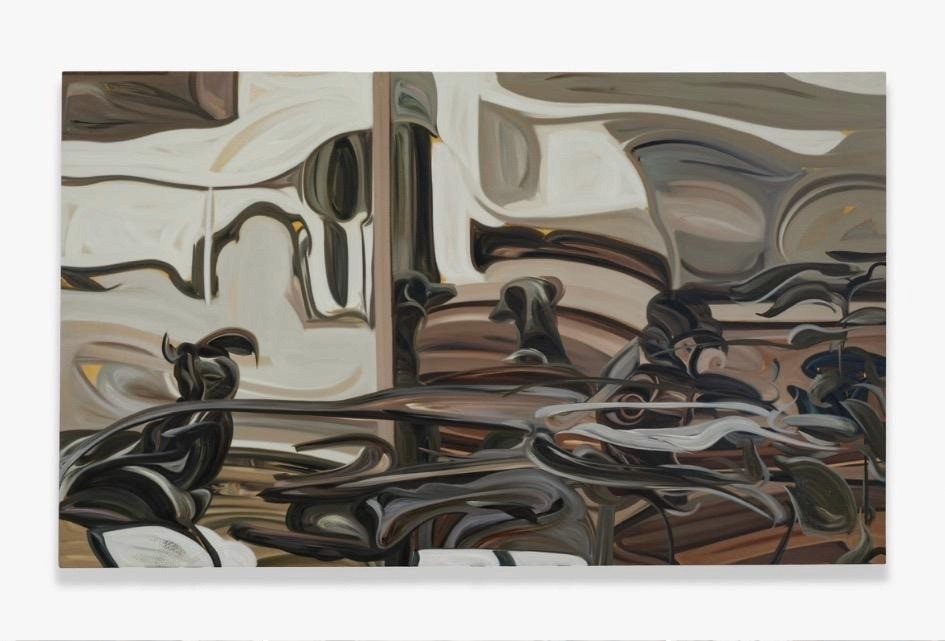 | 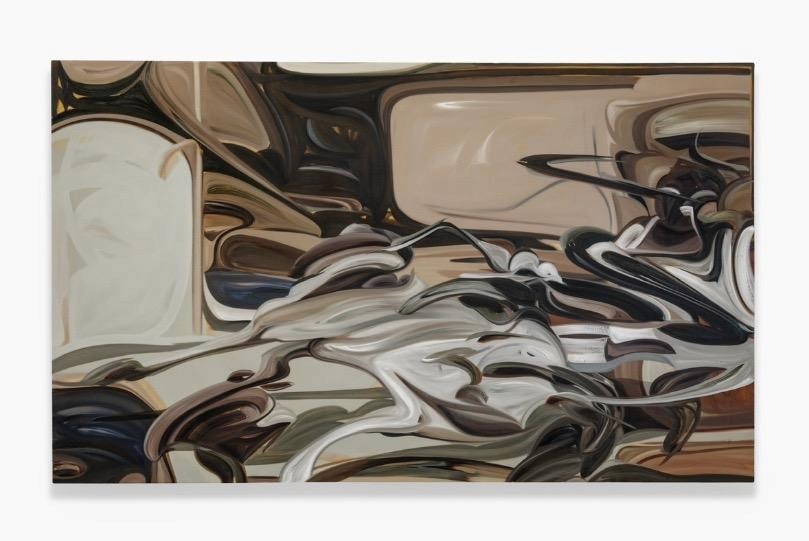 |
Luke Agada, Manoah I and Manoah II, 2026. Oil on canvas, 36 × 60 in each. Images supplied in the artist’s exhibition inventory.
ARA: With Manoah, you said you were drawn first to the sound of the word and then to its meaning — rest, repose, tranquillity. How do titles arrive for you, and what does rest mean inside these unstable compositions?
LA: I make use of personal symbolisms in my paintings. When I come across certain words, I consider the emotional texture of the word — how it sounds to me, what it makes me feel — and then I go to what it actually means and try to find a relationship. Sometimes words jump at me and I write them down, then I go and look for them and see that they are real words and that they mean something. Titles often come late in the painting. I have an idea of what the painting is, but the title is an additional layer of thought. Some titles come even without me working, so I document them and, when the right painting comes along, they become associated with it. I was drawn to Manoah because of the meaning of rest. Even in a stage of chaos and tension, there is still this question of finding a centre, finding a centre of gravity and being centred. Rest becomes complicated within a condition of instability. I am interested in rest not simply as the absence of movement, but almost as something one has to find or construct. You have to fight through it to make meaning. You have to fight for your peace, actually. In the context of this exhibition, tranquillity is not necessarily the result of everything being stable. Perhaps it is something we learn to locate even when instability remains.
ARA: You mentioned Okwui Enwezor before. When did you first encounter his work, and where does it sit in your thinking now?
LA: I got to know Okwui's work around 2018 or 2019, not too long before he passed. I looked more closely at his work during graduate school at the School of the Art Institute of Chicago, and I wrote a paper on The Short Century. It was part of what introduced me to the postcolonial paradigm. I was looking at curators like Okwui Enwezor and Bisi Silva, and writers such as Edward Said, Gayatri Spivak, Homi Bhabha and Stuart Hall. That began to give me a better understanding of the postcolonial paradigm, what happened post-independence, the stratification and structuring of the world, and why things are the way they are nationally, racially and geographically. I would say I am still early in that conversation. I feel like a child discovering so many toys. There is still a whole lot to learn, and I see the need to understand the past if we are to engage meaningfully in the present.
ARA: Was encountering those postcolonial writers and curators in graduate school an awakening or a refresh for you?
LUKE AGADA: It was an awakening because it helped give language to things that I was thinking about before then. I was trying to enter conversations about globalisation, the postcolonial paradigm, race and identity politics, but I was trying to find a way to enter them that was not clichéd. My interest in these topics comes out of my own curiosity and my interest in understanding how systems work, how the world works. Encountering postcolonial theory in graduate school was a eureka moment. It helped me finally develop the lexicon for what I was trying to do in the studio. And it is still growing.
ARA: Is there still a jump between that intellectual thinking and the canvas?
LA: There is still a chasm, because there is only so much painting can do. We often demand so much from painting. It is limited in its own way, and it is slow in arriving to add another layer of interpretation to these conversations. I admit the limitation of the medium. Probably sometime in the future I am going to explore film and montage. Right now I am conveying the sensation, the texture of the feeling I get from what I am exposing my mind to and coming to understand better. That is why the way I compose is a kind of world-building, creating a space within a space and allowing the figures to function according to a dreamlike logic. I think the most effective way for me to use painting to enter these conversations is through an abstract and surreal approach. I think it is better to make films than to try to make illustrative historical or narrative paintings. Books, films and animation have done that better. There is something else painting can do. Painting has a way of drawing the viewer's attention to think critically because you are no longer necessarily seeing a mirror of the world you know. You are being offered a different entry into it.
ARA: I keep thinking of Enwezor's phrase 'permanent transition'. It feels close to what happens in these paintings: everything is in flux, nothing is what it was or what it becomes. Does that make sense to you?
LA: Yes. Culture is going to continually be redefined and reformed. Culture is not stable, and cultural identity — how we define elements of culture — is not completely permanent in itself. It is constantly redefined. It is not always easy to reconcile what an artist is thinking about with what they are able to make. Sometimes it is a hit or miss. Sometimes it is close, and sometimes it is a journey. One work cannot completely define the idea of a career, or even one singular body of work. But when you keep looking and looking, repeating and checking again, you begin to see patterns. The dots begin to connect, and it begins to make more sense.
 |  |
Luke Agada, Synapses No. 39 and Synapses No. 40, 2026. Charcoal on cotton canvas, 27 × 23 × 2 in framed. Images supplied in the artist’s exhibition inventory.
ARA: One thing we had not talked about properly was drawing. Where does drawing sit in your practice, and how important is it to the painting?
LA: Interestingly, I arrived at drawing as an intervention for me to understand parts of the painting and what is going on — almost as an x-ray into the painting. That is why the drawings often come after a painting is completed. They are not studies that the painting is based upon. They are a way for me to sit down and explore the painting again, to study it with a different set of eyes. There is something about drawing that feels so honest. When you make a line, you can hardly hide very much. The line stays there and you have to perform within what that line can do. You have to improvise. When I am painting, some of the marks I am making are automatic. My hand is moving faster than my mind can comprehend or interpret. I allow the physicality of painting itself to be expressed so that I can surprise myself too. I am not just the maker of the image; I am also an audience. When I am done, I stand back and see what is working, what needs to change, what needs to be emphasised and what needs to be pushed further back into obscurity. Drawing helps me look again and understand what is going on.
ARA: Why call the drawings Synapses, and why use charcoal on cotton canvas?
LA: I use the Synapses series to explore memory as a fleeting network of connections. I think about the way impulses travel through the body and are interpreted, and I think about drawing, or art-making, in a similar way. There are parts of the process that are obviously very slow, but there are some parts where I cannot wait to think. I just have to act. Then I see what I have done, and I have to face the implication of that mark. I can revisit it through drawing. I use a charcoal stick on cotton canvas because of the resistance the cotton has against the charcoal. I have tried many different materials, but I do not want it to feel too easy to make a very legible image. I want something that resists what I am working with. When I feel the density of charcoal in my hand and work against the fabric, it allows me to feel the implication of every mark I make and every movement on the surface. That is important to me. It is like writing or speaking: every word you say matters. It reminds me to be careful about what is said, what goes out of me as a form of communication. We have to understand the weight of the consequence of the mark we make — in the work, in history, as an individual and as a collective. That is why I think of the drawings almost as receding echoes of moments within the paintings that continue to call back to me.
ARA: You sound very analytical when you talk about the work. In the act of drawing, how much analysis do you bring to it?
LA: Hardly any, actually. I cannot be too analytical when I am making the work. If I am too analytical, I would lose that miracle moment. When I allow my body to move and feel my way instinctively through the process, that is when the magic happens. Then I look back and stand back in awe and think, 'Oh, wow, that happened. I can work with this.' I am analytical to the point of having a strong intent in terms of composition, because when you approach a painting or a drawing, what reads to you is the distribution of the elements. The immediacy of the work is what attracts you at first. If a composition is strong enough, it attracts you and keeps your gaze long enough to see what is actually going on. If you look too quickly, there is a lot you will miss. I am using a strong composition to bring the viewer closer, to look closer at what is happening.
ARA: If someone went into the exhibition and had to pay close attention to one thing — painting or drawing — what would you want them to look at, and why?
LA: I have different audiences. I had people who came in — more of the older generations — looking closely at the drawings. There is such a quiet resolve that the drawings have that you have to appreciate little moments to truly appreciate the drawing. I like that because the process for me is quiet. It is almost meditative. When I am drawing, it is like a refreshing breeze of cold water. It is a quiet moment. I had older people appreciating the drawings, staying longer and asking more questions about them.
ARA: I keep thinking about Ibrahim El-Salahi when I look at the drawings. In some of his best drawings, figures seem to levitate without needing a ground. In yours, I can still read floor, wall and contour. If those pointers disappeared, would that represent progress to you, or is that just another possibility?
LA: I like to position the figures or the forms within a space, to find a way to anchor them and give a sense of location. I think about the background, the space, in terms of standing and being connected to the earth, as far as gravity is concerned. I think about how things fall, the resting state of an element in the world. When gravity acts upon an object, it tries to find its centre and find balance. Even though most of the elements in the painting are quite abstracted, I try to find the centre of gravity so that the composition is balanced and at the same time holds a lot of tension. Giving it a sense of space is important to me right now.
“Interviews conducted 31 August and 21 September 2026. Edited and condensed for clarity.”
more stories
In Conversation
The painter on returning to Accra, colliding London with Obuasi, and why she lets a painting go above 90 percent.
8 Mins Read

In Conversation
Recorded at ARAMI, Lagos, during a press preview for Pure Water, Chika Idu’s solo exhibition with SMO Contemporary Art. In conversation with Sunshine Alaibe, Idu traces water through childhood drought, environmental precarity, the Atlantic slave trade and the changing representation of women in his work. By Sunshine Alaibe Edited by Sabo Kpade 17 September 2026. This conversation has been condensed, reordered and edited for clarity.
10 Mins Read

In Conversation
Gabriel Selassie Tsagli left Ghana at eleven and lived in Germany for twenty-six years. He returned to Accra in 2024 and made the paintings in Son of Kafui—his first proper solo exhibition at home—in a single stretch between February and this summer. He does not use a colour palette, works on many canvases at once, and calls the show a graduation. This conversation was recorded in Accra in August 2026 and has been edited and condensed for length and clarity.
6 Mins Read

In Conversation
Orry Shenjobi on her Venice residency: raffia craftwork, studio life, and what she learned — with takeaways for artists eyeing their own residency.
4 Mins Read

In Conversation
Ralph Waldo Emerson, in his essay "Society and Solitude," wrote, "We do not believe our own thought; we must serve somebody; we must quote somebody; we dote on the old and the distant; we are tickled by great names; we quote their opinions; we cite their laws." For Ikechukwu Nduka, he stands as the antithesis of the society Emerson critiques. He defied societal expectations and familial disapproval to pursue his passion for art, successfully contending the dependence on the opinions of others. "They say art is therapy, but while creative minds like us are creating this 'therapy', I think we need it the most, or rather we need it first." He aptly expressed the stark pressure.
7 Mins Read

In Conversation
Windsor Gallery is becoming a prominent player in the West African art scene, expanding its influence from Lagos to Abuja and Abidjan in just a few short years. This growth signals not only the gallery's ambition but also its commitment to creating a platform for contemporary African art.
6 Mins Read
In Conversation
In Ethiopia, women vendors are often overlooked and marginalized, despite being the backbone of the market. Their struggles are perpetuated by societal perceptions of their stature. Challenging these norms, Tadesse Mesfin's solo exhibition, "Where We Coalesce," currently on view at Addis Fine Art (until November 30, 2024), seeks to reframe the narrative surrounding Ethiopian women.
5 Mins Read

In Conversation
In the midst of shifting societal norms and increasing complexity around identity, "Freedom in Multitudes" asks important questions about Black and African identity. Through the work of nine international artists, this 1897 Gallery exhibition explores the nuances of self-expression.
5 Mins Read

In Conversation
On this podcast, we delve into the stories of Key Industry Players in different art ecosystems on the African continent. We speak to Gallerists, Art Historians, Curators, Advisors & Art Directors to get insight on their markets domestically.
1 Min Read

In Conversation
Within Nigeria’s creative scene, Olufisayo Bakare stands as a multifaceted force. Born in Lagos to a family with a rich art and design heritage, her interests took her through the intricacies of various industries. From aspiring artist to entrepreneur and curator, Olufisayo is the visionary behind the brand, interior Living (Intlvng) and The Yellow of Lagos.
7 Mins Read