In Conversation
EMMA PREMPEH
The painter on returning to Accra, colliding London with Obuasi, and why she lets a painting go above 90 percent.
SHARE

8Min
Emma Prempeh made half of this exhibition in Accra and half in London, and the two halves do not match. The Accra paintings run to yellow ochre and bright earth; the London ones went grey. She spent three months at dot.ateliers in Accra earlier this year, reading, travelling to Cape Coast and working in a studio other artists walked through while the canvases were still half finished. She went partly to see her father, whom she had spent years not painting. What came back was a set of collisions: a London bus rerouted to Obuasi, and the Crystal Palace transmission tower standing over the Ghanaian school her father named after the south London park. She is not certain any of the paintings are finished.
When did this body of work first begin for you?
EP: It happened maybe nearly two years ago. I had this idea to revisit some things in the past I had let go in terms of my relationship to Ghana and my father. I hadn’t had a residency since 2024, which was in Kampala; 2021 was the first residency I had in Ghana. It didn’t feel right for a lot of those years before having the residency this year. I wanted to reclaim my experience, to push a project of discovering a bit more about the diaspora and my connection between the places my parents are from, and to deepen my knowledge with literature. So I thought, why not have a residency I can go to that allows all of those things to take place? And to see my dad as well and build that relationship too.
Did the residency at dot.ateliers change your practice — technique, ideas, materials?
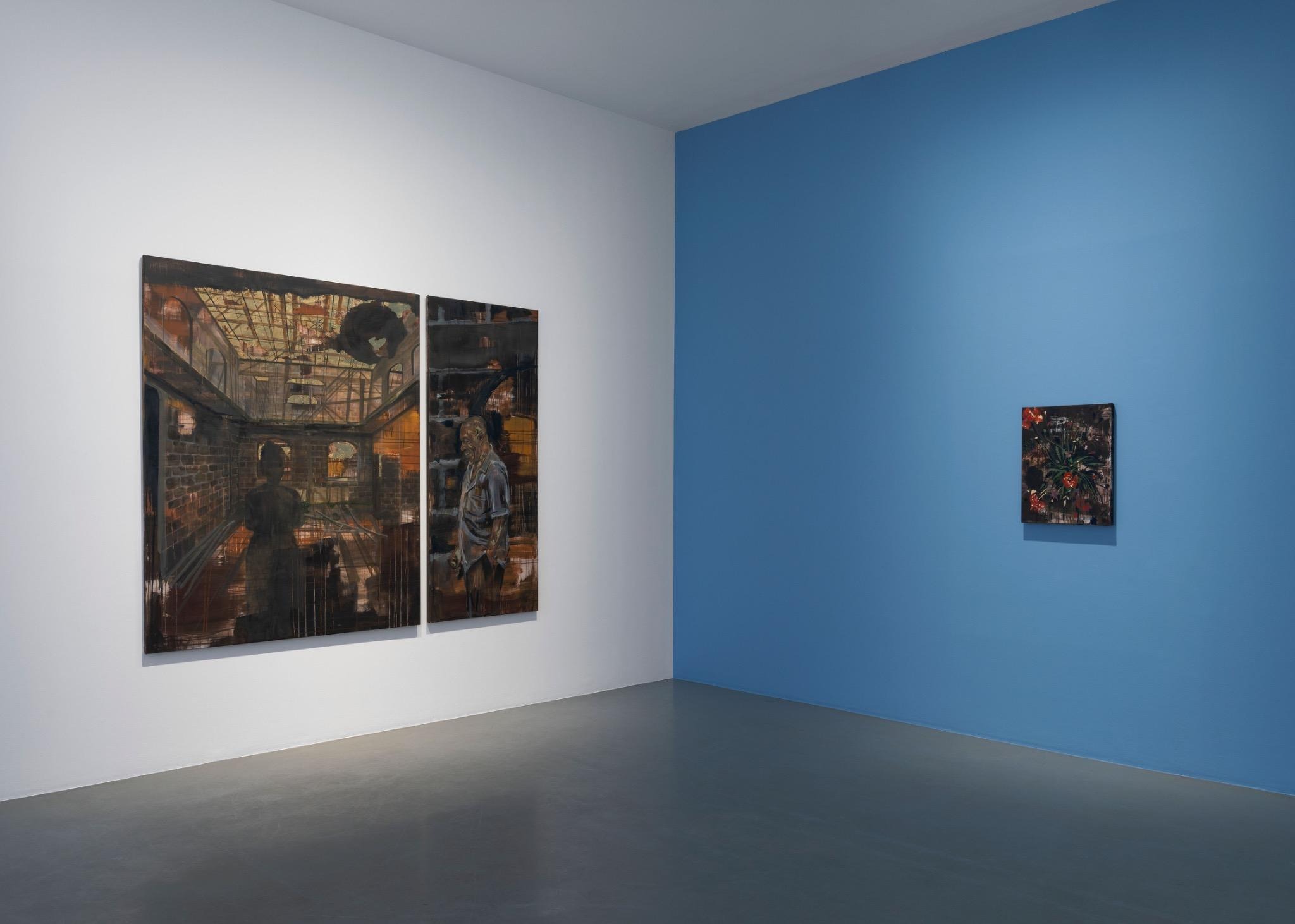
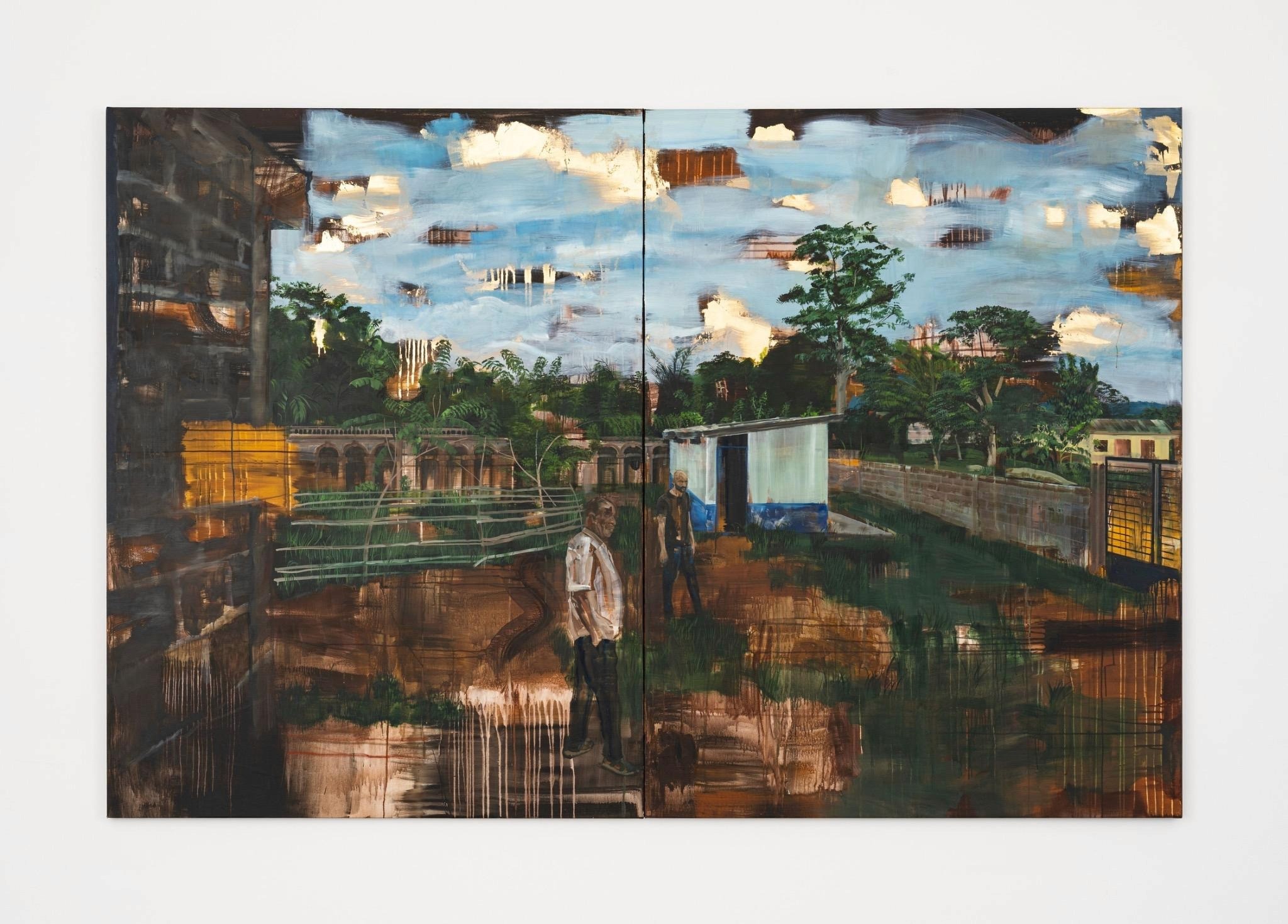
EP: Yes, it really changed it, in ways I had forgotten in the past. Particularly when I was in Accra, the landscape really influenced how I was deciding to use colour. I haven’t been diving into landscape but I started to use a particular colour, yellow ochre, a bit more. These fractures of bright, earthy colours that were a little brighter than the tones I usually use. So that influence of being there really impacted the work, and it was interesting to then make the second half in London. It was really interesting to do, because they were two completely different concepts: the works in London felt darker, a bit more grey, kind of mimicking the atmosphere in London. I was thinking, how are these going to connect, and what will they look like next to each other? I think it’s worked out well.
Was your process in London different?
EP: Very. In Accra, I had other artists with me — Daniel Quarshie and Matthew Eguavoen — who split their time when I was there. I was there for three months, and we had a lot of people coming in and out. So I felt really uncomfortable, in the sense that I’ve never had people come to my studio when the works are half done. But in a residency, the works are half done and they’ll say, this is amazing, this is great, and I’m like, it’s not finished. It’s almost like I’m peeling my skin off and they’re looking at the flesh before I’ve put it on. In London it was way more private and very comfortable.
In Crystal Palace School (2026) you trace a connection between Crystal Palace Park in London, where you grew up, and the school your father founded in Obuasi and named after it. How did that painting come about?
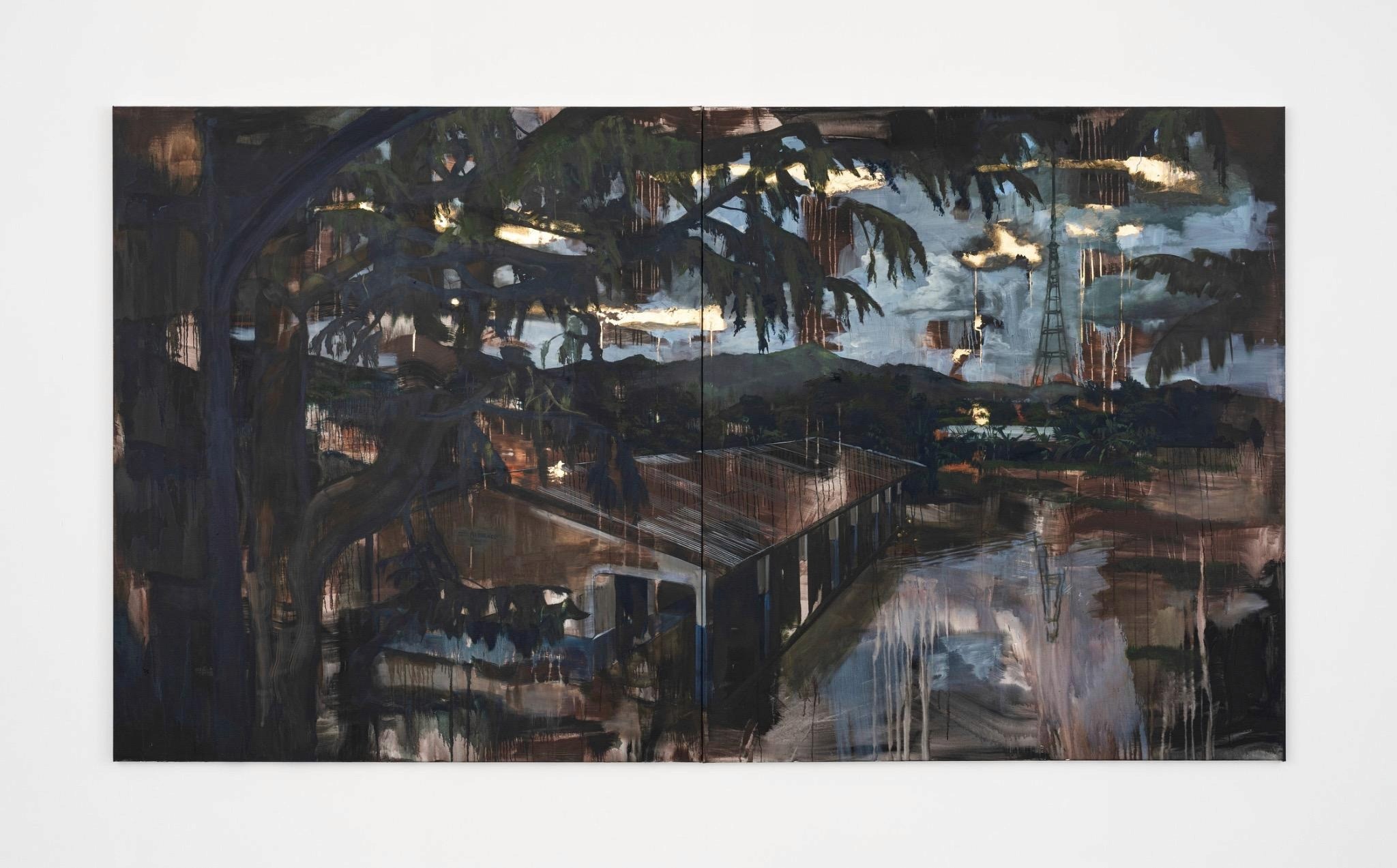
EP: When I was researching at the beginning of the residency, I was thinking a lot about portals, and the situations my dad landed himself in in London, and then taking some of that back to Obuasi. The fact that he called it “Crystal Palace Preparatory School,” it was as if he was still trying to keep that connection to London. I thought, why not mix the two places, almost becoming this portal, because I don’t really have a relationship with Obuasi, but the name really is familiar to me. That was really interesting, because it was the first piece where I decided to try and collide the landscapes.
And the painting behind you, with the London bus rerouted to Obuasi — you are placing recognisable images inside a world you actually know.
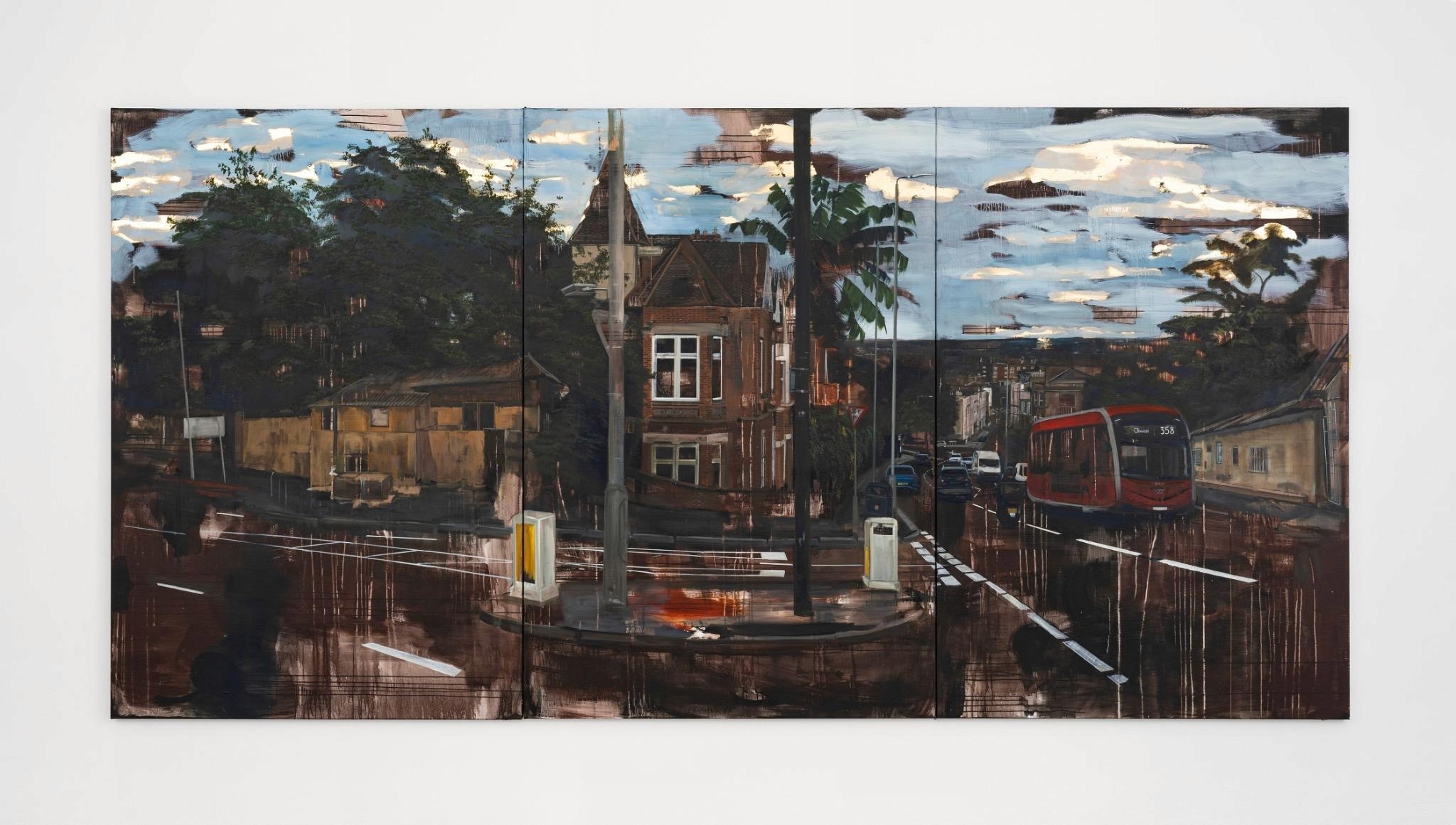
EP: It was really fun to do this one, because I was thinking, what can I do to show the two narratives? Obviously the London Red Bus, and changing the name to Obuasi, might throw off people that are from the area in a sense — but it was interesting.
Some of your earlier paintings — To Nene and Carrie, I’m here again (2024) — carry a distinctly matrilineal thread. Is it important to know your own past? Can a person exist without their history?
EP: Yeah, to an extent, because if you are other, if you are different, especially growing up as a child, you’re faced with that before you even understand what that is. Difference, especially being in Europe, is shown a lot. So then you naturally ask that question — am I from here? I don’t look like anyone else. If othering happens, you’re naturally asking, where do I actually come from? And where would I feel more comfortable, more embraced for who I am completely? So I think it is important, but at the same time, if people find home in the situation they’re in and they’re comfortable with that, I would say you don’t have to.
The title comes from Saidiya Hartman’s Lose Your Mother. In the prologue, after three children at the bus station in Elmina call her obruni, Hartman writes, “The domain of the stranger is always an elusive elsewhere.” Is that why you chose it?
EP: Yeah, I really love this quote from Saidiya Hartman’s book. I love that she expresses that we are a stranger to a domain we don’t have any foot in, and what is the domain? Because of the extraction of your history, your heritage, your ancestors, it highlights that even when I’m in Ghana, I’ve still thought I’m an outsider; and when I’m in St. Vincent — which I haven’t really been to a lot — I’m still an outsider. And politically, even more so than growing up, I’ve always felt like a stranger in Britain.
How do you arrive at titles? Do they come before the painting or out of it?
EP: After [laughs]. It’s probably the most frustrating thing. When I work with someone, they’re like, we need a title, but I can’t give you the title until I feel it right. I hate being rushed with titles, but this one came naturally. I just called it 358 to…, because when you’re in London, the bus is always named after the end destination and the last stop. So, yeah, played on that.
Empire is the reason your family is in Britain at all. Does that history sit inside these paintings?
EP: Yes, I think so. When you think about Empire, the reason my family came to the UK was because of it: the Windrush generation on my mum’s side, and my dad was a little different, he came to England for work. But it naturally moved my family to England. So yeah, it definitely does.
Why did your family become such an important archive for the work?
EP: Yeah. It first came about because it was the only thing I could easily access. When I was thinking about history, my past, why I exist, I then looked up to my mum. Why did she meet my dad, my grandma, why did she decide to come to the UK? Because they were part of those questions I had early on, I thought this was the first part I’d like to tackle. And then slowly it shifted to different spaces. Luckily, actually, Ghana, and then also the Caribbean.
How did your family feel about being represented?
EP: My mum loves it [laughs]. She’s never been able to tell her story well, and growing up now, I’m nearly 30, she’s told me so many things I didn’t know as a child. I’m exploring that. And then also my dad: because we have such a disconnection, I don’t really care about what he thinks. But he has seen the work. He is quite appreciative of the way I’ve painted him, even if he might not know why. A lot of my family members want to be painted, but I think it has to come quite naturally.
What did Rembrandt teach you about darkness?
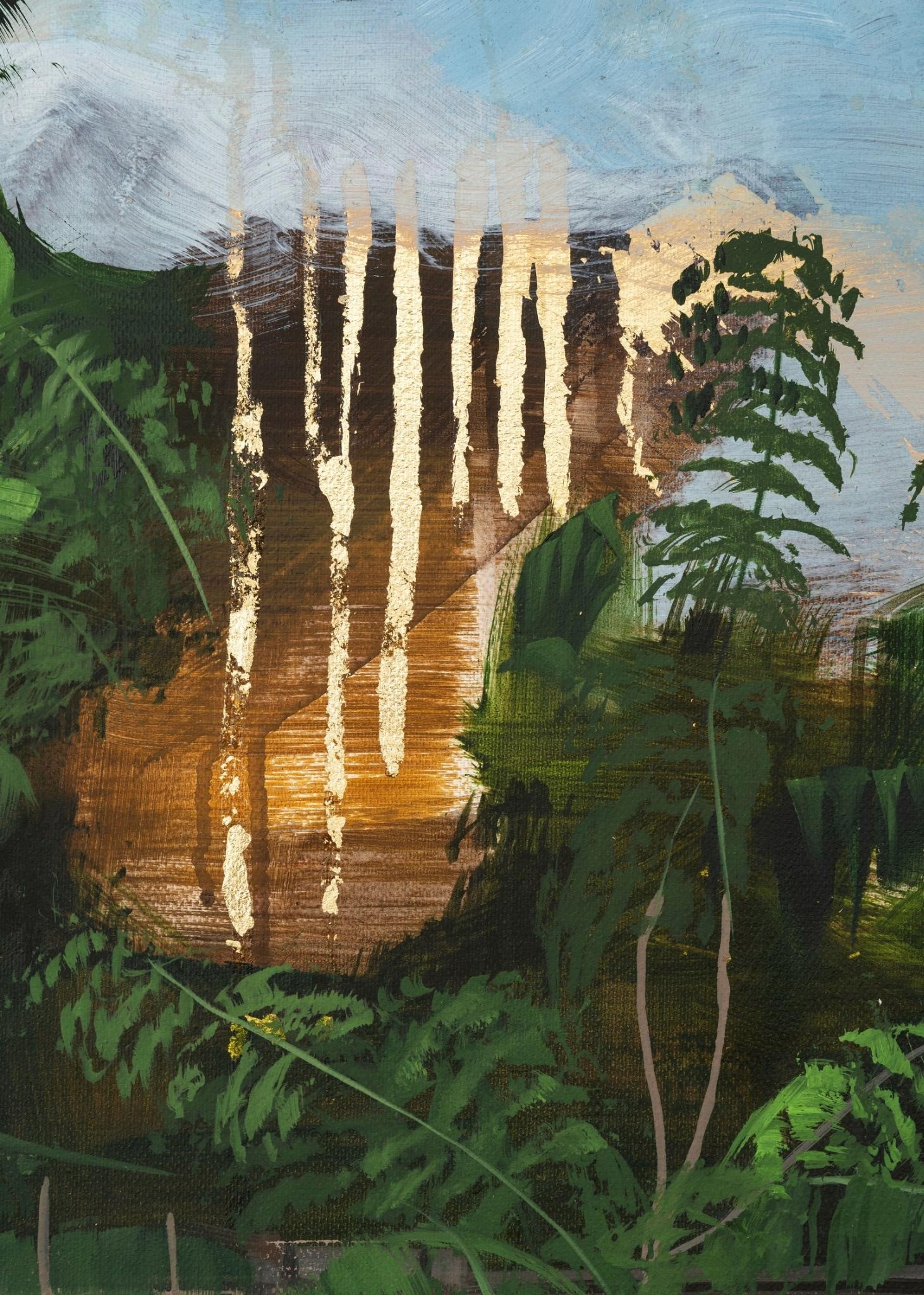
EP: I’m inspired by Rembrandt, and I feel like I break the rules a lot in painting. Sometimes colour or light doesn’t make sense in my work, and I’m like, is this intentional? Because I’m meshing so much imagery together, it’s sometimes hard to get the light right. I remember seeing my favourite painting, Philosopher in Meditation by Rembrandt. There was something really atmospheric about it; it drew me in. The way he used really dark light and brown tones — I always felt I would love that to be a point of my work, the light capturing the light. In the landscapes, mostly it’s in the sky, because I wanted it to represent transition with the schlag metal, which oxidises over time. And sometimes I like to include gold leaf in people to represent time, or light. There are some pieces in the show that are broadly just representing light. That is definitely taken from that, over many years. I think I was first introduced to that work in my undergrad at Goldsmiths.
When do you consider a painting finished?
EP: [Laughs] I don’t. I could say that in this show, I don’t think any of them are. I always say that I work in percentages: if everything is above 90 percent, then I can release it. But it has to be above that, if it’s below, it’s not complete enough. I feel I could work on a piece forever, and sometimes that ruins the work, when you’re too particular, too perfect with it. Over the past few years it’s been a process of letting it go, and just accepting that if it has all the elements I need, I can release it.
Do you go back to paintings?
EP: A lot now, actually. Because obviously the body of work keeps increasing, I keep going back to pieces I found really fun, or that had elements I kind of released. There are a few works in the show that have texts, and I used to do that in my earlier solo shows. It was nice to see some kind of relationship between writing and painting. And because the residency was very heavily based on research and reading, I thought it was really nice to include that.
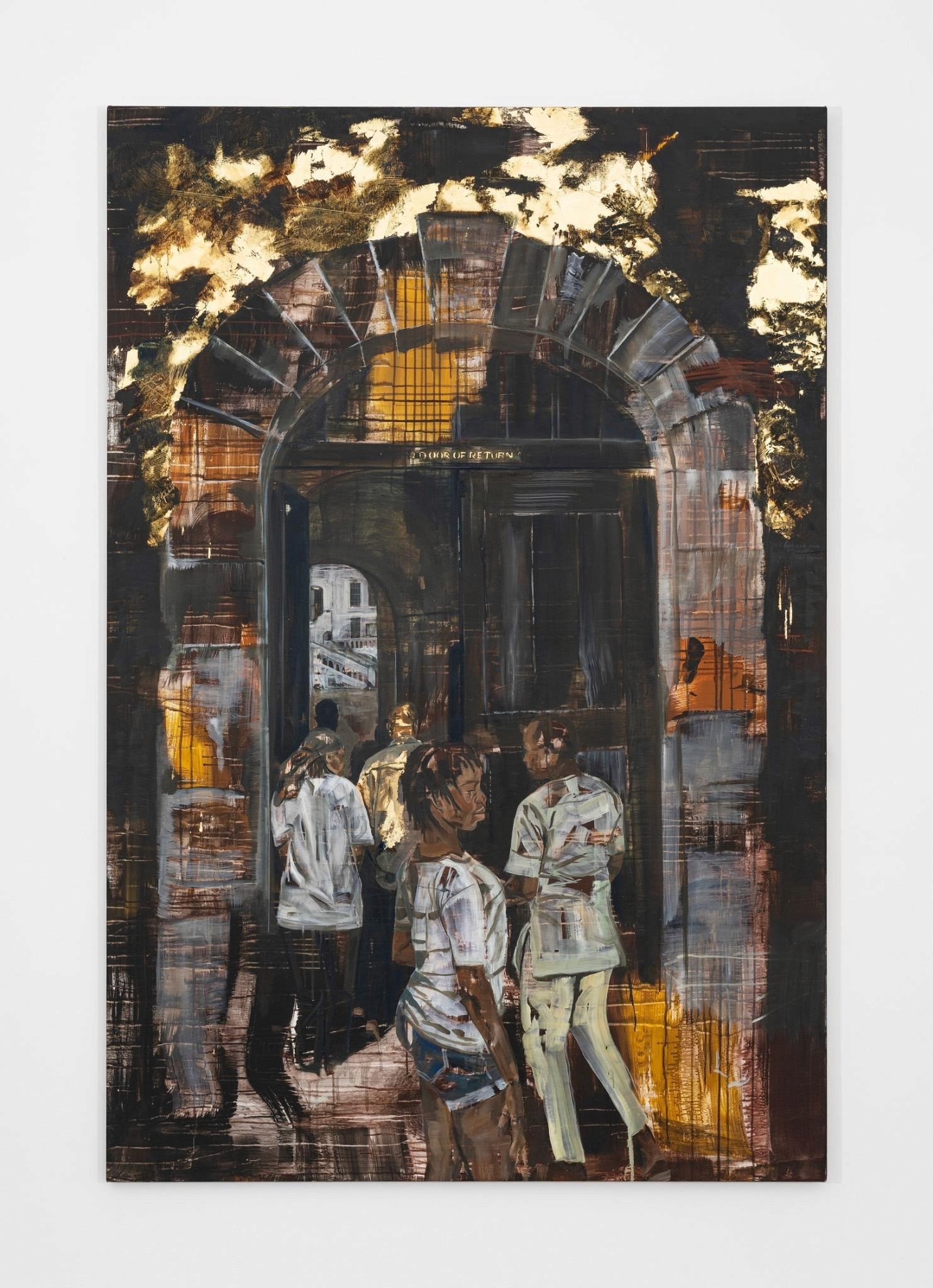
Return was, and still may be, an intention (2026) takes its title from Dionne Brand’s A Map to the Door of No Return. Is the archway an in-between, transitional space? What did the Door of No Return allow you to think through?
EP: Yes. In Accra there was this library of the diaspora, and I was so inspired by that massive collection. I met someone there who was doing a writing residency, and he said, you need to read this book. I was like, okay, I’m going to read this. Naturally, because I had been to Cape Coast, the door of no return became a picture that linked so much — because throughout the book, Brand always talks about seeing the door without seeing it, or feeling it, because she knows that in her ancestry, people left through there, and that’s what made her who she is, essentially. I thought it was a nice way to introduce people to the show: either walking through or exiting. And how a lot of us from the diaspora have that odd feeling of, can I go to Africa? Can I feel rooted? Can I feel at home? Or even when it’s like “go back home”, because we’ve been removed from it for so long, what does it mean for us? Will we be accepted there? So that piece in particular, I really just love the meaning of. It says “door of return”. It’s like an invitation: yes, we can. We can seek more of our history.
Brand’s door is a point of rupture, but your paintings keep crossing between periods and places. Does painting let you pass back through it?
EP: Yes, and Ghanaians are really inviting people. They’re quite open with people buying land or making homes, even if you’re American, and so far removed from the continent, you’ll still be invited, you know. I kind of appreciate that about Ghanaians. I guess Ghanaians who live in Ghana might have different views, but I understand them too.
Do you imagine audiences in the UK, France, Saint Vincent or Ghana engaging differently with this material?
EP: A hundred percent. I had no idea in the beginning how it would be received, because a lot of the things I’m looking at aren’t necessarily in relationship to Paris. That’s why I think Glissant’s book, Poetics of Relation, is important, because it has that small relationship between someone who wants to describe it in their own words — and also, I’m discovering what communities are here, whether it’s Caribbean or African communities. There’s still that similarity, in a way, even from his book, about creating this new community, crossing the sea, and making a new language. I love that about it, and I thought it would be a nice introduction to the Parisian audience, to have his words as part of the show.
There are clear visual dialogues between works in the show. How involved were you in the curation with Brice Arsène Yonkeu?
EP: Very heavily. Me and Brice have worked together; I told him about this idea from the very beginning, and he says he feels like he’s been in my brain for the last year — and it has felt like that [laughs]. So I love the communication, working out where things should go and solving it, and also him being introduced to new work as the process went along. I had a big hand in the way the pieces are situated together, the conversation they have with each other, and also the texts I decided to use.
What still feels unresolved in these paintings?
EP: I feel like this is the very beginning of something. There’s so much more literature I want to finish. So this exploration will continue, and specifically the meshing of worlds. How can I make it more seamless? I feel like these works are not as seamless as how I envision them in my brain. I have no idea what I’ll be showing in the future — it’s quite an uncertain period for me at the moment — but I’m hoping that I just continue to fall in love with this process.
Emma Prempeh (b. 1996) is a British artist of Ghanaian and Vincentian heritage.
The Domain of the Stranger is at Perrotin Marais, 76 rue de Turenne, Paris, until 26 September 2026. Emma Prempeh’s recent solo exhibitions include The Nearness of Elsewhere, 87 Gallery, Hull, and Belonging In-Between, Tiwani Contemporary, Lagos, both 2025. Her work is in the collections of The Hepworth Wakefield and The Harris, Preston.
This interview was filmed at Perrotin and has been edited and condensed.
Nana Poulot is a writer based between Tokyo, Paris and London. She contributes the Paris entries to Things to See This Week.
more stories