
Editorials
Frank Coffie: Between and Almost Far from Hard Walls
Frank Coffie’s first solo exhibition in Ghana follows his participation in WorldFaze’s Visiting Artist programme. He builds his paintings backwards — yarn first, paint last — using offcuts from his younger brother’s tailoring shop. We walked the exhibition together on a Saturday afternoon in August, stopping at the works as we came to them.
SHARE
6 Mins Read

ARA: I don’t like normal beginnings. I could ask about title, inspiration, all of that, but the thing that is very strong here, the moment you come in, is the attention to fabric — the obsession with fabric. So rather than start at the beginning: for people who don’t know your work, when did the yarn first enter it, and what does it do that painting alone cannot?
FC: It was 2015, when I went to South Africa to study. I took some old paintings along, and I wanted to give them life after I realised they were damaged. So I had to cut them into pieces and then I found a thread I was able to stitch them together with, to give them life. The thread was able to give them life at that moment. So it was in my mind to explore it further if I got the opportunity. After school I decided to try yarn, and when I tried yarn I realised it was combining perfectly with painting. It was giving deeper meaning to what I wanted to express, what I wanted people to feel, what I wanted people to connect and relate to in life.
ARA: When you say “give life” — if you had to explain it — what does that mean?
FC: I wanted to have a signature. As an artist you should be able to have a signature. And I wanted to have a voice. I wanted my voice to be so loud, even though I’m speaking very softly. I wanted people to feel my mood, to connect with my character, without me having to explain my work.
ARA: Before that, did you have a childhood or previous interest in yarn and fabric? Or did it really come as a practical problem — trying to stitch these things together and realising it could be something?
FC: Back in school I had a mentor. His name is Igshaan Adams. He was very much into tapestries and things like that. He works with yarns, he works with beads, all kinds of leather. He was a mentor to me. At that time I was painting in oil, but using a wet-on-wet approach, where it seemed as if I was using watercolour when I was using paint. Alla prima. He encouraged me not to be scared of the canvas: I should just be myself and flow. So I picked one or two things from him. And West Africa is very big on textile, so of course it looked very familiar when I decided to work with that material, to tell my story, where I’m coming from, my culture, how I was growing up.
ARA: And what the fabric was at the time — has it changed since then?
FC: I began with thread, then I moved to heavier yarns. And my younger brother is a tailor. So sometimes I go to his place and take fabrics he will not use again. When you look at my works you see fabrics in them as well, and sometimes you see beads. It is determined by what I find.
ARA: Is there a deeper connection beyond the fact that it’s your brother and he’s giving you the offcuts? Do you source materials anywhere else?
FC: No, just him. Just the ones he won’t use again, that are not useful to him any more. I take them and give them life. It has been going on since 2024. That’s when I realised the colours were interesting. It looks like waste to him, but as artists we are always conscious about giving life. So I realised there is something I can do with this — something I can tell people about my life, what I go through, where I come from.
ARA: How do you decide which part of each painting deserves the fabric and which part deserves to be painting? It isn’t easy to tell from outside, looking.
FC: It’s very random. We go with how we feel. We are always conscious about our emotions and we allow them to direct us in the work. So I move in a very random space. It’s like playing ping-pong — okay, this will be here, this will be here. And it’s always the first thing I do. The last thing I do is the painting. Always last.
ARA: Speaking of random — I can’t take one clear story from these. They seem cherry-picked from different parts of your life and memory. Different stories, different people. What is underneath? Who are these people?
FC: This particular one talks about my family and how supportive they are when it comes to spiritual matters. In our country there is always a group of people, even a single person, who will dedicate their life to spiritually back you when they see potential in you. I feel very privileged to have those people around me. And when you look carefully at the painting there is one person who does not look like something you are familiar with. We don’t know how a ghost looks. That represents my grandmother. She passed on a year ago. I decided to represent her in this because — you know how we as Africans, as Ghanaians, are more connected to the dead than to the living. So I feel there is more connection even though she’s no longer around. She’s still connected to me spiritually. And there’s my mother, and my sister, and my partner.
ARA: That’s powerful, because I decided not to read the text before looking at the painting. Going around the first time, then the second time, the best I could come up with by way of guessing was: this reminds me of the first time I had to leave home at twenty-three to go to England, and my mother called all the women in the area to come and pray. That was the closest I could connect: that this is somehow about the prayers of women over the lives of men. Before I even got into the painting I was asking, what is that spectral, ghost-like figure? What are the mountains doing?
FC: And she’s the only person with two hands, holding. Connected to them more than to the living.
ARA: So having explained why your grandmother is a ghost-like figure — how did you decide what to dress each of the other women in?
FC: It was randomly selected. I wanted to create some sort of rhythm, and to incorporate the rhythms in kente into the piece, to have that Ghanaian vibe in it.
ARA: You didn’t use the typical kente that we know.
FC: No, just the patterns, to represent it. My works are mostly full of patterns, rhythms and movement. If there’s a certain movement I like to incorporate it, just to tell people where I come from and some of the things you see if you come to where I come from.

ARA: It’s strong work. The next one that struck me when I came in was Pots of Love, the portrait of the couple.
FC: It’s a series. It talks about love — everyone has experienced heartbreak, or moments where we ask, why am I not among people who are perfectly in love? It starts with Pots of Love, the first one, where there are a lot of flowers. The flowers represent material things; they are not limited to flowers. And you can see the lady’s facial expression gives the viewer that energy to ask questions. Is she appreciating what the guy is doing? And the third one, which you’re asking about, is Pots of Love II, and that’s where the guy is insecure about whether he made the right choice to be with the woman. There’s a little insecurity in it. And then the last one, where the lady is holding a very big flower and the guy is nowhere to be found, and people have to ask: is he dead? Is he still alive? Are they still together? Has she moved on? Have they gone their separate ways? So it’s just the questions we ask when we are in love, when we are going out of love, and what we do to be in love, whether it goes our way or not.
ARA: Flowers feature heavily. You said they represent material things. Why flowers specifically?
FC: You know how flowers are very significant in our communities, and how beautiful they are. They don’t give you bad energy. So it has to be good things. And I didn’t want to limit it to painting a phone or painting a car, where it would be very direct. It has to be more of a conversation.

ARA: I noticed the figures are outsized, but not hugely so. Why are your figures at those proportions, and not close to human scale?
FC: My figures are mostly semi-abstract, just to give that freedom. Back in school I was told you should learn how to draw — when you learn how to draw, then you are able to distort the figure. I always applied that principle in my work.
ARA: One major part of this show is also the tapestries. How do they sit inside Between and Almost Far from Hard Walls?
FC: These are a sort of template for how I deal with pain. They come from a period in my life where I had a particular way of dealing with pain or trauma. Some of the things I do: get lost in the sun, go to the beach, spend time with family and friends, sometimes go to the gym, sometimes go to church. So when you pay attention, sometimes I move according to the wind, and sometimes I give up just for a moment and then quickly rise again. When you look carefully you can see there’s a time where I go to the gym, a time where I pray, a time where I spend time in solitude, a time where I get lost in the sun. And sometimes I give up: not totally, just for a moment. So it’s a template for dealing with pain. It’s very relatable.
ARA: So they’re self-portraits?
FC: You can say that.

ARA: A couple of works that don’t fit the clear narrative of love. This one — is it from memory?
FC: It’s a memory. Growing up, we didn’t have a TV. So we always had to go and watch TV at our neighbours’. And sometimes you have to be quiet, even if you are the loudest person. At the slightest noise they either close the curtains or turn the TV off. It was a fun childhood moment, but it was also a painful one. And I’m privileged now that I have my own TV. I don’t have to go and watch somewhere else. So it’s a childhood memory, a childhood pain I had to deal with, and one I’ve completely overcome.
ARA: The remote balanced on the TV is the best thing in there.
FC: I had to tone it down. And you know how the rooms are mostly blue — the walls painted blue, everything almost blue. I wanted to capture that as well.
ARA: I’ll leave that one and ask about the boxer. Another figure that doesn’t fit any easy narrative here. Who is it, and what’s happening?
FC: The boxing has every connection to life, and how we are all boxers even though we don’t put on the uniform. If you look carefully he’s wearing a helmet, which puts him at amateur level. He is new to this, but he’s paying full attention because he doesn’t want to disappoint, doesn’t want to give up, doesn’t want to lose whatever he is fighting. You become a boxer when you’re dealing with pain. There’s a time where you box, and there’s a time where you sit and pay attention to your opponent, where everything is blacked out and you just pay attention to your opponent.
ARA: Do you use black paint, or do you mix all the colours to arrive at black?
FC: This particular one, I used black. I wanted it to have the richness of black, where everything is blacked out and everything is focused. You know how sometimes in a film, when a boxer is between giving up and not giving up, they black everything out, even though the arena is very loud and very noisy. So you blot everything out and just focus on your opponent.
ARA: Was it important not to base the painting on any one boxer? Because that would be instantly recognisable.
FC: That’s the reason. The reference image was a female boxer, and I decided to do it again. Even though I had a reference, I wasn’t completely in the reference. I allowed myself a representation with no resemblance to anyone, aside from the flag.
ARA: What happens if you make the female boxer? Just sticking to the original source image.
FC: It has nothing to do with gender. I feel it’s mostly a men’s game here, and it wouldn’t be something I’d be able to relate to.
ARA: How would you define an artist?
FC: Someone who is very sensitive, someone who is very emotional, someone who pays attention. And that cuts across every form of art you want to attach yourself to.
ARA: How would you define art itself?
FC: Art is a very secret way of telling people your secret. And when it becomes something you want the world to know, then it becomes no secret.
ARA: “Art is a very secret way of telling people your secret”?
FC: Yeah. I think that is something I’ve never thought of, but it came out very naturally. I might not be able to explain it or break it down, but I feel it’s very genuine and very understandable.
ARA: I’ll hold on to that, and argue with it after I leave here. The exhibition title is hardboiled and a little cryptic. Between and Almost Far from Hard Walls — what are the two conditions?
FC: To break it down, it’s about resilience culture. It’s about having a relation to the resilience culture among Black people, and how we can have conversations that do away with systemic adversities, to promote emotional wellbeing and financial stability.
ARA: What are your expectations for the exhibition?
FC: It’s open. I’m hoping every Ghanaian would come and see it, come to know the name Frank Coffie because this is just the beginning. There’s more I’m going to show the world. Come and have a conversation about pain. There’s no day we don’t deal with a wall. Your wall might not be my wall, but there might be one or two templates here that can help you deal with your daily walls.
Between and Almost Far from Hard Walls is at WorldFaze, East Legon, Accra.
Edited from a recording made in the exhibition, 15 August 2026. False starts, overlapping speech and repetitions have been removed; phrasing, idiom and order are otherwise the artist’s own.
more stories
Editorials
Thread that turns into faces, bronze that becomes a crowd, ceramic coral clinging to a sunken object, a "painting" that turns out to be a quilt: the Nigerian artist Jacqueline Suowari takes us on a tour of the fair at the Javits Center in New York, pointing out the five works that rewarded her for stepping closer.
8 Mins Read

Editorials
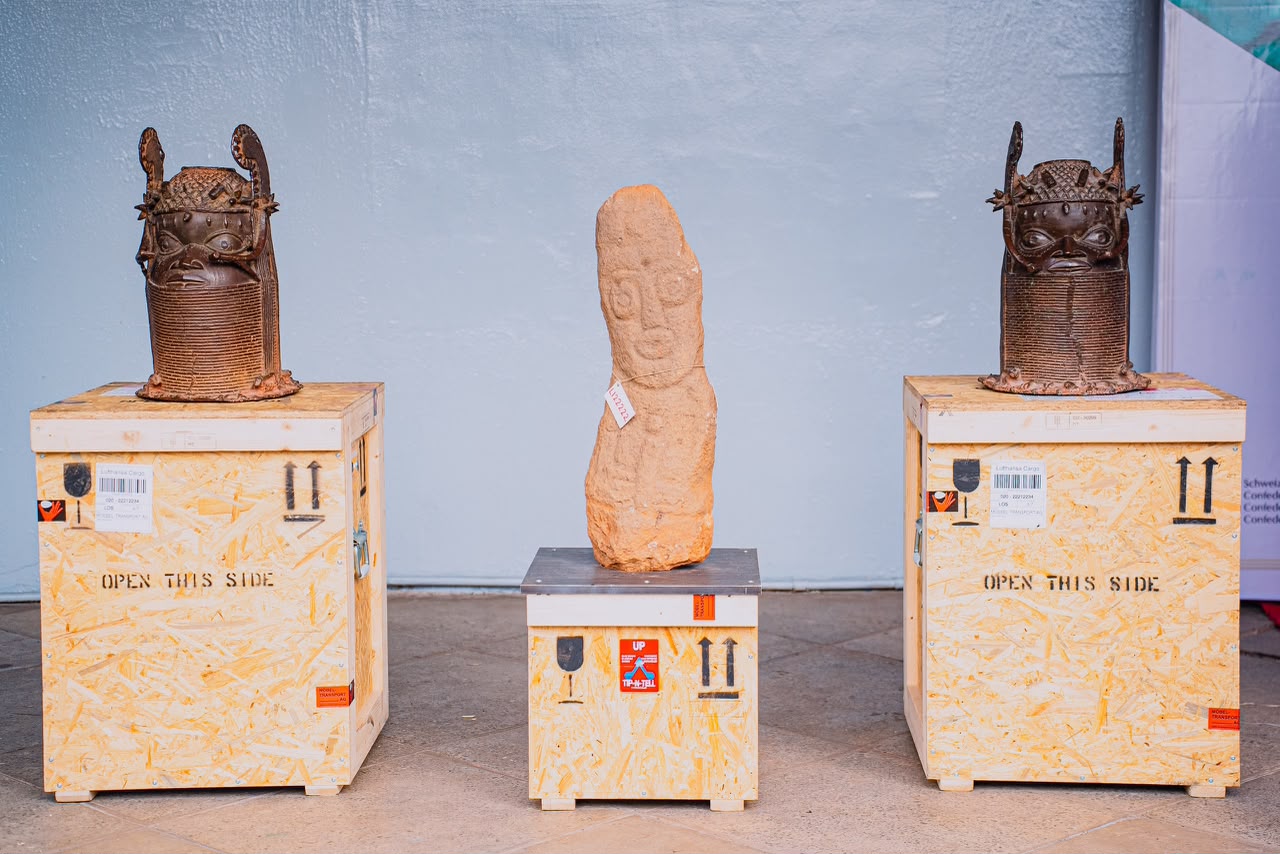
Switzerland's return of eighteen Benin Bronzes and four Ikom monoliths is a milestone in a restitution movement that is starting to outpace the institutions meant to receive it.
8 mins
Editorials
Dianna Offor, nicknamed "God's Artist," is a Nigerian-born visual artist, whose work is dedicated to expressing the essence of God and importance of faith in todays society. Currently living in Ireland–where she recently acquired a diploma in studio art painting, Offor has spent the last three years depicting the theme of Hope and Love through her biblical abstract paintings.
13 Mins Read

Editorials
Last week, Art Report Africa served as the official media partner for New Narratives and Singular Communication in Arts Journalism: The Museo del Prado Experience — a two-day international workshop held at the Yemisi Shyllon Museum of Art, Pan-Atlantic University, Lagos, organised in partnership with the Embassy of Spain in Nigeria and Casa África through its #PeriodismoÁfrica programme.
2 Mins Read

Editorials
On 14 June 2026, the Obama Presidential Center unveiled "The Obamas: Springing Forth" — a large-scale work by Njideka Akunyili Crosby, rendered in acrylic, coloured pencils, charcoal, and transfers on paper, measuring 108 by 120 inches. It now hangs in the Hope and Change Lobby of the museum's main building, free and open to the public, before the Centre's official grand opening on Juneteenth. It is the first official portrait of the former President and First Lady together.
3 Mins Read

Editorials
The 2026 Venice Biennale is, on paper, the most African edition in the exhibition's 131-year history. But what does that actually mean — and who does it serve?
5 Mins Read

Editorials
The Pavilion of Zimbabwe announces its participation in the 61st International Art Exhibition of La Biennale di Venezia, opening in April 2026 under the artistic direction of Adriano Pedrosa and the central exhibition In Minor Keys.
2 Mins Read

Editorials
There's a voice that lives inside us, often waiting in silence. It's a part of ourselves that we sometimes bury, a quiet shadow that only finds expression when we allow it to. Yusuff Aina's latest character, "Voied," is a compelling new light for this hidden self.
3 Mins Read

Editorials
In response to a growing chorus in the global art world declaring that “Black figuration is over,” O’DA Art Gallery’s latest exhibition, Black Figuration is Alive and Well, offers a firm and timely rebuttal. Bringing together a dynamic group of contemporary artists working across painting, sculpture, photography, collage, and digital media, the exhibition argues for figuration not as trend or aesthetic repetition, but as a vital language of presence, imagination, and agency.
2 Mins Read

Editorials
In the nuanced world of art collecting, the process is often as significant as the acquisition itself. Whether motivated by aesthetic appreciation, investment potential, or cultural enrichment, collectors must ensure that their decisions reflect both their personal values and long-term vision.
3 Mins Read

Editorials
For the first time in art market history, female African artists collectively surpassed their male counterparts in auction sales in 2023—a development initially dismissed as an anomaly. Yet, the trend persisted into 2024, with women artists securing a commanding 52.8% share of total African art sales.
3 Mins Read

Editorials
At a time when conversations about diversity, representation, and identity are more important than ever, Bozar’s latest exhibition When We See Us offers a powerful exploration into how we perceive ourselves and others.
1 Min Read

Editorials
Curated by Osei Bonsu, curator of international art at Tate Modern, and Cale Garrido, guest curator at the C/O Berlin Foundation, A World in Common presents twenty-three African and African diaspora artists from different generations and geographical contexts - with works by Kelani Abass, Atong Atem, Malala Andrialavidrazana, Edson Chagas, Kudzanai Chiurai, Rotimi Fani-Kayode, Maïmouna Guerresi, Hassan Hajjaj, Délio Jasse, Julianknxx, Samson Kambalu, Kiripi Katembo, Lebohang Kganye, Mário Macilau, Sabelo Mlangeni, Santu Mofokeng, Fabrice Monteiro, Aïda Muluneh, Wura-Natasha Ogunji, George Osodi, Dawit L. Petros, Zina Saro-Wiwa, and Khadija Saye.
2 Mins Read

Editorials
As September gets to its mid point, now is a good time to look at what October promises for the art world, with fairs and auctions spanning continents, spotlighting both emerging and established talent.
3 Mins Read

Editorials
Imagine growing up surrounded by art that wasn't just on the walls, but woven into the very fabric of Lagos. That was the world of Mrs Rayo Anthonio, daughter of the legendary Yusuf Grillo.Yusuf Grillo's story is one of dedication and quiet revolution.
5 Mins Read

Editorials
Anjola Awosika gives insight to his mission for this series: "I'm on a mission to unfold the vibrant African narrative through the lens of food and interior photography. I thrive on encapsulating the richness of our diverse culture in every shot, whether it's the savory essence of our cuisine or the allure of stunning interior spaces. Join me in this exhilarating journey at the core of my media agency, where we celebrate the beauty of African life through the captivating art of photography."
1 Min Read

Editorials
Debuting this month, Anjola Awosika announces "Ànjolá", an Interior Design project celebrating African culture in African homes. Looking at how functionality, comfort and Art coalesce in living spaces, Awosika is determined to document the intricate details that contribute to the beauty of specific African homes.
1 Min Read